
Your needs, this model
Does it fit your priorities?
Do you need an older Brother M-cassette system rather than choosing by tape width alone?
The exact U.S. PT-100 brochure identifies Brother M tape at 9 and 12 mm; this assessment does not treat the conflicting current TZe data field as proof that the PT-100 uses TZe.
Explore this need in the finder →Would an alphabetical letter-key layout suit you better than QWERTY?
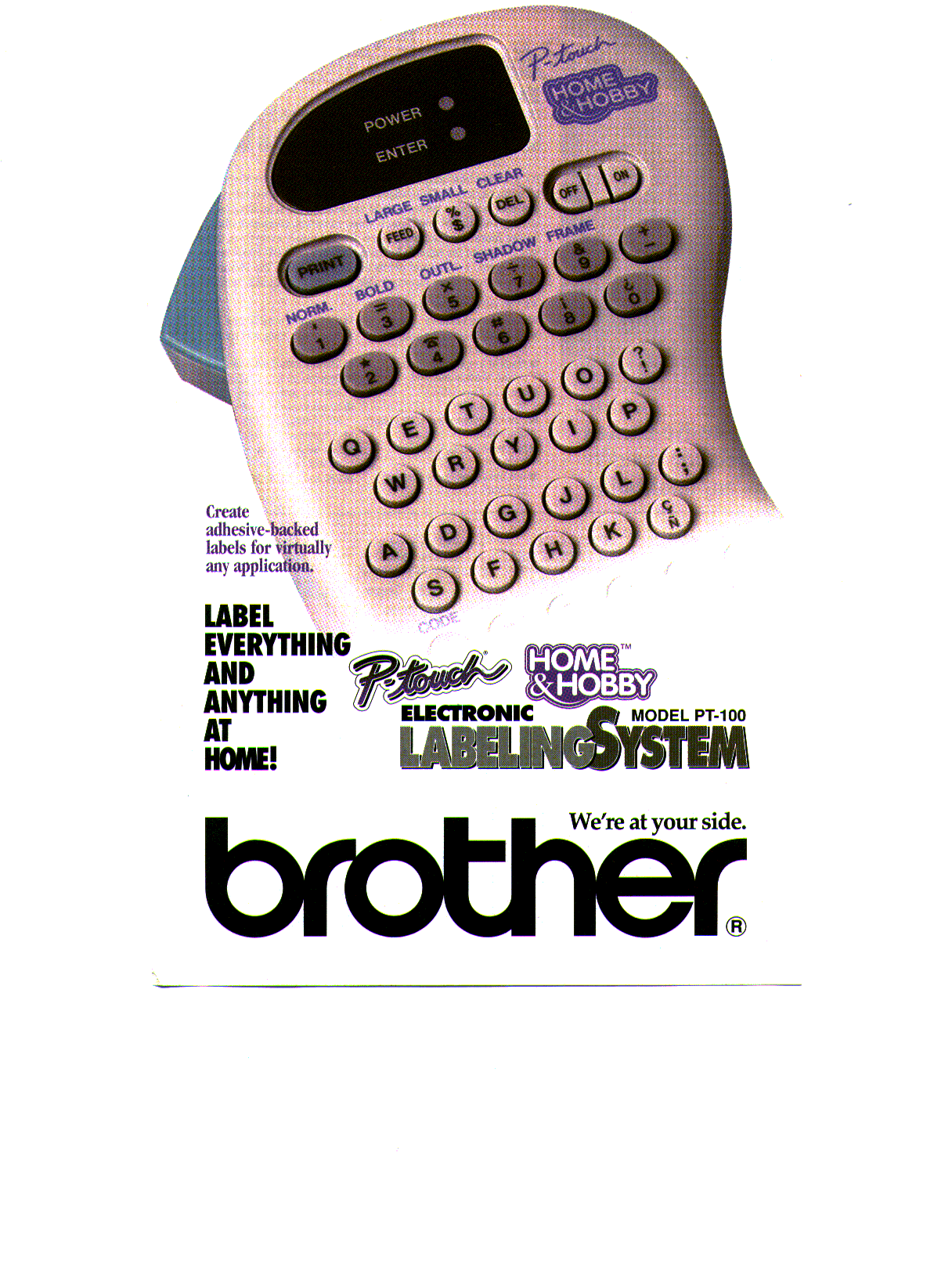
Brother's original model brochure calls the PT-100 keyboard alphanumeric, and its visible key rows are alphabetically arranged. The live specification panel says QWERTY; because these disagree, the matcher only uses the brochure-backed alphabetical layout and excludes an essential QWERTY request.
Explore this need in the finder →Is a built-in phone app or a guaranteed print height essential?
The brochure documents local keyboard operation but does not document a phone-composition route or a numeric print-height limit. Unknown capabilities do not satisfy those essential requirements.
Explore this need in the finder →An earlier handheld whose cassette identity needs care
Brother’s PT-100 is a discontinued Home & Hobby labeler built around keys on the machine itself. Its original U.S. brochure calls it the “Model PT-100” and presents an alphabetical alphanumeric keyboard, rather than a phone-first printer. That makes this a useful reference for someone identifying an older unit, not a current new-product recommendation. The broad format is simple: enter a short line at the device, select a type size and style, and print on a narrow cassette label.
There is an important evidence conflict. Brother’s exact U.S. product page links the original PT-100 brochure and M-series supplies, but its current technical-data panel says TZe tape, 3.5/6/9/12 mm, a QWERTY keyboard and a two-line maximum. The brochure attached to the exact item says 9 and 12 mm M tape, an alphanumeric keyboard and does not state a line maximum. The printed key layout is alphabetical. Because that brochure names the exact model and the same product page points to M-series cassettes, this assessment treats M at 9/12 mm and alphabetical keys as the narrow documented plan. It does not quietly convert those facts into TZe or QWERTY support. I did not find a PT-100 U.S. user guide linked on the Brother support page checked, so other operating limits remain unknown.
What the original brochure supports
The brochure describes two character sizes—10 and 16 point—and four print styles: normal, outline, shadow and bold. It advertises labels in two widths, 9 mm and 12 mm, using Brother M cassettes, and describes a tape-cutter blade. Its image shows a small indicator area marked Power and Enter, not a wide text-preview display. This supports an uncomplicated, local entry workflow, but the brochure is not detailed enough to promise a certain character capacity, line count, numeric print height, automatic cutter or print speed. Do not let a matching cassette width stand in for a matching cassette family.
Brother lists six AA alkaline batteries as the power source and says the cells are not included. The brochure gives a 1.0-pound weight without batteries and body dimensions of 6.6 × 4.3 × 2.1 inches, but it does not label the axis order. Those numbers can help set expectations for an older handheld; they are not reliable width, depth and height limits for a storage slot. The same brochure says one 26-foot (8 m) M cassette was included in the original package. That is a historical box description, not a promise about a used listing. Ask the seller to show the cassette and all included parts rather than inferring contents from a brochure.
Who might still want one?
The strongest fit is an owner who already has a working PT-100 and can confirm the M cassette system from the machine or its instructions. For occasional pantry, household-file or hobby labels, the two font sizes and four styles provide more than plain block text while staying simpler than a connected desktop setup. The width choice is limited to the brochure’s 9 and 12 mm M cassettes. If your current workflow depends on TZe, 18 mm tape, a phone application, a specific computer connection, automatic cutting, or a minimum print-height guarantee, this review cannot qualify the PT-100 for that essential need.
The battery requirement is another practical filter. Six AA cells are not a rechargeable pack, and an AC adapter is not established in the checked exact U.S. brochure and support page. The cutter blade is mentioned, but without the manual I cannot responsibly say how it is actuated or whether any setting cuts automatically. For a station where mains power, a particular cutter behavior, fast repeat printing or exact physical fit matters, choose a model with a manual that settles those questions instead of assuming this older machine does.
How the choice changes with your supplies
For a PT-100 owner, the first question is the tape family on the cassette and the instructions for that exact machine. The Brother product page’s technical panel is not enough to settle this model’s media because it conflicts with the exact brochure and the product-page M-supply links. The finder therefore includes the PT-100 only in an earlier-model M-tape plan; it does not treat the page’s TZe field as a second verified configuration. If you need a specific tape system as a must-have, an unresolved specification should not be counted as a match.
Compared with a newer current-reference machine, the PT-100 is an archival, used-unit choice with older M media and no verified app or computer workflow in the sources checked. Compared with the earlier PT-85, it has a different documented control set: the PT-100 brochure lists four styles and two sizes, while the PT-85 brochure lists more styles, more sizes and a display; both need individual cassette checks because Brother’s current specification panels conflict with their brochures. The PT-100’s real attraction is narrower: an owner can identify its exact M-tape widths, compact brochure-era body and direct keyboard routine. Check the model name, cassette, battery compartment and operation before committing to an old unit, and do not treat availability of compatible tape as established by this historical review.
Key details at a glance
| Full-color output | No |
|---|---|
| Maximum tape width | 12 mm |
| Compatible cassette | The original U.S. PT-100 brochure explicitly names M tape in 9 and 12 mm widths, and the exact U.S. product page links M-series supplies. The same live page's technical-data field says TZe at 3.5/6/9/12 mm and its keyboard field says QWERTY. Those fields conflict with the brochure; this profile is limited to the exact brochure's M plan and does not treat TZe as confirmed. |
| Display type | LED and sound indicators are shown/described; a readable text display is not established. |
| Line-count note | The exact U.S. PT-100 brochure does not state a line-count limit. Do not infer one from the current product-page two-line field, which is part of the conflicting live technical data. |
| Power choices | Brother's original PT-100 brochure says six AA alkaline batteries are required and not included. The checked exact U.S. brochure and support page do not establish an AC-adapter route. |
| Body dimensions | Brother's original brochure lists 6.6 × 4.3 × 2.1 inches but does not label the axis order. It is not encoded as a width/depth/height constraint; measure the actual older unit for a tight storage opening. |
| Tape cutting | The brochure advertises a tape-cutter blade that cuts tape cleanly and safely. It does not establish the PT-100 U.S. cutter actuation method or automatic-cut capability; the exact U.S. user guide was not found on the checked support page. |
| What the base package supplies | Brother's original brochure says the PT-100 package included one 26 ft (8 m) M tape cassette. This historical box description does not establish what remains in any particular used listing. |
| Letter-key arrangement | alphabetical |
| Specialist media limits | The PT-100 brochure describes M cassettes in 9 and 12 mm widths, including metallic tape colors. It does not establish current cassette availability or specialty-film operation. |
| Built-in type styles | ['normal', 'outline', 'shadow', 'bold'] |
Use the exact model’s instructions for operating limits, supplied equipment and version differences.
Sources for this assessment
Put the device and its tape system together.
Match the exact model, cassette family, computer or network route and any optional power or touch-panel hardware before buying.