
Your needs, this model
Does it fit your priorities?
Do you need Brother M tape, or are you looking for standard TZe?
The exact PT-110 brochure names M tape at 9 and 12 mm. The live US table says TZe, but that conflicts with the original model brochure; strict matching counts only M.
Explore this need in the finder →Would a discontinued handheld that prints up to two short lines on M tape fit?
The PT-110 brochure documents up to two lines and 9/12 mm M tape, but four display characters do not provide a full-label preview and no numeric print height is specified.
Explore this need in the finder →Can you type locally, or is a phone app essential?
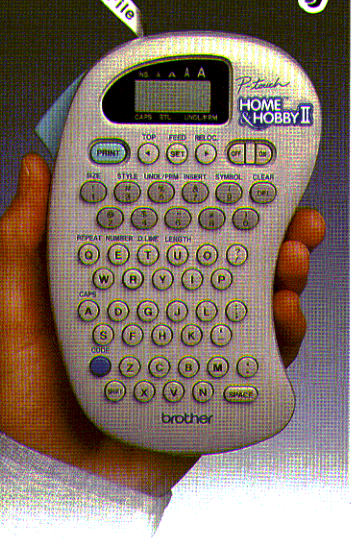
The brochure documents a 50-key alphanumeric built-in keyboard. It does not settle the key arrangement or document a phone-app route; the current US table’s QWERTY claim conflicts with the brochure image and wording.
Explore this need in the finder →A discontinued handheld whose tape family matters more than the headline specs
Brother’s PT-110 is the Home & Hobby II handheld labeler shown in its original U.S. product brochure. It is a useful machine to identify if you already own one or are evaluating a specific used PT-110, but Brother marks the model discontinued, so it is not a current default recommendation. In this case the cassette is the first buying question: the old brochure names Brother M tape at 9 and 12 mm, while today’s U.S. page attaches a generic TZe specification panel to the same model. Those are different tape systems, not interchangeable widths. I use only the older M plan documented for this exact machine and leave the current table’s TZe claim out of the strict match.
What the PT-110 was designed to do
The Home & Hobby II is a self-contained keypad machine. Brother’s brochure describes a 50-key alphanumeric keyboard and a four-character LCD for editing, not a large screen that shows an entire label. You type on the device, select a format and print. The brochure lists four character-size modes: 10-point normal, extended and condensed options, plus 16 point. Six styles are named—normal, outline, shadow, bold, italic and vertical—and it also shows text framing and underlining. Sixty built-in symbols are listed. That is a more expressive set of local controls than a bare one-line labeler, but it is still a small, older interface; do not expect to compose a long design on a computer or phone.
Two-line printing is explicitly listed in the PT-110 brochure. That can help when a short label needs two brief lines, but the sheet does not give a maximum printable height in millimeters or establish a numeric character limit. Its screen is only four characters wide, so a longer message will be edited through a small moving display rather than previewed as a full layout. If exact print height, a visible full-label preview or saved-design capacity is essential, the documentation available for this model is not enough to qualify it.
M cassette, not a width-only decision
The original U.S. brochure identifies two cassette widths: 3/8 inch (9 mm) and 1/2 inch (12 mm), both in the older Brother M-Tape line. It describes metallic color choices and an adhesive-backed output, and says the original carton included one 26-foot (8 m) M cassette. Brother’s current Canadian page for the same PT110 model also groups M-family supplies with the product, while its current U.S. specification table lists TZe at 3.5, 6, 9 and 12 mm. Because the model-specific brochure and live technical panel disagree, the safe decision is not to treat every 12 mm cassette as compatible. Check the cassette mark and the instructions for the exact unit before sourcing refills; the brochure does not establish today’s supply availability or the condition of any used cassette.
This also limits where I would choose it. The sources do not establish that PT-110 output has the environmental ratings of a current TZe system. For labels exposed to repeated wiping, moisture, heat or solvents, do not infer durability from the P-touch name or from a tape’s color. Choose a current model whose exact media and application guidance cover that surface, or test a sample label on the real material before making a batch.
Power, package and the used-unit tradeoff
Brother specifies six AA alkaline batteries, not included, and gives a weight of 1.0 lb without batteries. The brochure’s body dimensions are 6.6 × 4.3 × 2.1 inches, but it does not label the axis order, so treat those as a rough envelope rather than a width/depth/height promise. It takes six separate AA alkaline cells; the brochure does not document a rechargeable pack or a charging route, and the checked exact U.S. evidence does not confirm an AC-adapter route. The brochure pictures a cutter blade and says it cuts tape cleanly; it does not specify actuation or promise automatic cutting.
That missing detail matters more for a secondhand machine than a spec sheet suggests. Before buying one, check that the battery compartment is clean, the cassette cover latches, a known M cassette feeds, the display responds and the cutter assembly is present. The old brochure’s included starter tape describes the original carton, not what a present listing contains. Ask for a photo of the actual underside/nameplate and the cassette installed in the machine rather than assuming a complete package from the model name.
Who should keep it—and who should choose differently?
The PT-110 is most relevant to an existing owner who wants a reference for its 9/12 mm M cassette and locally entered two-line labels. If your requirement is standard TZe, a width above 12 mm, a phone app, USB design, wireless printing, an AC adapter, a guaranteed automatic cut or a measured body orientation, this assessment cannot count the PT-110 as a match: those facts are missing or contradicted, not safely inferable.
Compared with the earlier PT-100, the PT-110 brochure documents a broader set of size and style choices and explicitly lists two-line printing; the PT-100 brochure describes two sizes and four styles but does not establish a line limit. Both are discontinued M-cassette references, and both current U.S. pages carry tape data that conflict with their original model brochures. If either old machine is under consideration, identify the printed model and cassette first; do not substitute the PT-H110 or PT-1100 just because the digits look similar. For a new purchase, start with a current model whose specific cassette, power route and support documents match your needs.
Primary references: Brother’s PT110 U.S. product page, its PT-110 U.S. brochure, and the Brother Canada PT110 page.
Key details at a glance
| Full-color output | No |
|---|---|
| Print process | thermal transfer |
| Maximum tape width | 12 mm |
| Compatible cassette | The exact PT-110 US brochure names Brother M cassette widths 9 and 12 mm. The current exact US PT110 table instead says TZe at 3.5/6/9/12 mm. Brother Canada lists related M supplies for this exact model, but the strict US profile remains only the brochure-supported M plan; TZe is not inferred. |
| On-device preview characters | 4 |
| Display type | LCD |
| Maximum lines per label | 2 |
| Line-count note | Brother’s exact PT-110 brochure states that it prints up to two lines; this does not establish numeric print-height in millimeters. The current product table independently states two lines. |
| On-device symbols | 60 |
| Power choices | The original PT-110 US brochure says the unit operates on six AA alkaline cells, not included. The checked exact US material does not establish an AC adapter, rechargeable pack or charging route. |
| Body dimensions | The original brochure lists body dimensions 6.6 × 4.3 × 2.1 inches but gives no width/depth/height axis labels. Do not encode these values as axis-specific constraints; measure a particular used unit for a tight fit. |
| Tape cutting | The PT-110 brochure describes a tape-cutter blade that cuts cleanly and safely, but it does not say whether actuation is manual or automatic. No cutter workflow passes an essential need without a model-specific manual. |
| What the base package supplies | The original brochure says the PT-110 carton included one 26 ft (8 m), 9 mm M tape cassette. This old-package description does not establish what comes with any current or secondhand offer. |
| Specialist media limits | The exact PT-110 brochure supports M tape at 9 and 12 mm with several shown colors. It does not establish modern TZe, specialty media or present US supply availability. |
| Built-in type styles | ['normal', 'outline', 'shadow', 'bold', 'italic', 'vertical'] |
Use the exact model’s instructions for operating limits, supplied equipment and version differences.
Sources for this assessment
- Brother US Office & Home directory row PT110 at offset90/index93
- Exact Brother US PT110 product page
- Exact-model original Brother US PT-110 brochure
- Brother US exact PT110 product support landing page
- Brother exact US PT110 manual-index request (generic error response)
- Brother Canada exact PT110 page (non-US corroboration only)
Put the device and its tape system together.
Match the exact model, cassette family, computer or network route and any optional power or touch-panel hardware before buying.