
Your needs, this model
Does it fit your priorities?
Are you willing to keep an earlier PT-1130 on the manual-backed original Brother TZ cassette route?
The exact guide names original TZ (and Martha Stewart MTZ) at 6, 9 and 12 mm; the current page’s TZe/3.5 mm table conflicts, so the strict match uses TZ only.
Explore this need in the finder →Would a small QWERTY keyboard work if two lines are limited to 9 or 12 mm tape?
The guide shows a QWERTY device, an 8-character one-row display and two-line printing only on 9 or 12 mm tape; its 6 mm cassette route is one-line only.
Explore this need in the finder →Is a hand-operated cutter acceptable, rather than automatic cutting?
The guide shows a cutter lever and does not document an automatic cutter. It also documents six AAA alkaline cells or the optional Brother AD-30; package inclusion is not established for a used unit.
Explore this need in the finder →The Brother PT1130 is an earlier, discontinued handheld label maker for someone who specifically wants keyboard entry on the machine and can verify a used unit before relying on it. The exact Brother U.S. listing describes a QWERTY keyboard, laminated output and two-line printing. Its specification table names TZe cassettes, including a 3.5 mm width, but the model-specific guide says to use Martha Stewart Everyday MTZ or Brother TZ cassettes at 6, 9 or 12 mm. Those instructions conflict, so this assessment recommends only the guide-backed original TZ route; it does not promise TZe or 3.5 mm compatibility.
A short-text, on-device workflow
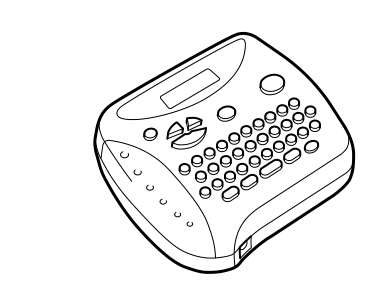
The PT-1130 is made for composing directly at its built-in QWERTY keyboard rather than for a phone-first or desktop-design routine. The guide shows the keyboard and an eight-character, single-row LCD. You can type up to 55 characters, but the display works as a scrolling window; editing a long name or instruction takes more cursor work than a larger preview would. This is a plausible fit for short file tabs, pantry containers, craft storage or drawer labels when the act of typing at the machine is acceptable. The exact guide does not document a mobile app or a USB computer-design workflow, so choose another model if either route is essential.
The guide describes symbols, accented characters, several type sizes and styles, repeated printing and numbering. Those are useful ways to vary a short label, not evidence of an editable template library, barcode workflow or modern batch-print software. The machine can hold up to nine text files and 300 characters in its memory, while a single working text can be at most 55 characters. If power is disconnected for more than three minutes, the guide warns that displayed text and stored text files are lost. It also switches itself off after five minutes without a keypress, then retains the active session while power remains available.
Keep the tape decision conservative
Brother’s current PT1130 page identifies the exact product as discontinued and lists thermal-transfer printing on laminated tape. Its live compatibility table says TZe and widths of 3.5, 6, 9 and 12 mm. The model-specific guide instead says “Martha Stewart Everyday MTZ or Brother TZ” and lists 6, 9 and 12 mm. Because this is a meaningful supply difference, the matching profile credits the guide’s original TZ widths and records the product-page TZe claim as a conflict, not as proven compatibility. The guide names MTZ too, but the site’s cassette choices do not provide an MTZ selection; if you have that cassette system, verify the cartridge marking and exact machine before buying supplies.
Line count changes what those widths can do. The guide permits a second line only with 9 or 12 mm tape, and two-line text prints in the normal size regardless of the chosen size setting. On 6 mm tape, plan for one line. The available guide-supported width tops out at 12 mm; there is no source-backed 18 or 24 mm path for an equipment panel or a large, highly readable sign. A laminated label is not a promise that it will adhere to every surface or tolerate every environment, so test the intended tape and surface rather than treating the material description as a universal durability rating.
Power and cutting still involve the operator
The manual documents six AAA alkaline cells and an optional Brother AD-30 adapter. It describes a hand-operated cutter lever; it does not document automatic cutting. That arrangement is simple for occasional labels but adds a manual action to each strip in a long run. The guide says a cassette is supplied with the original unit, but that does not establish what remains in a used listing today. Likewise, adapter compatibility does not mean an AD-30 is included. Treat current bundle contents and the condition of any old batteries, adapter or cassette as unverified until the seller confirms them.
The PT1130 can make sense as an inexpensive existing-machine or used-unit choice when direct QWERTY entry, a hand cutter and narrow original TZ labels fit the job. It is a poor match if you require modern software, app design, guaranteed TZe supply, wide tape, automatic cutting or a bundled power adapter. Brother’s PT-D220 review is a more practical comparison point for a current-reference handheld, but it is a different model; do not assume its supplies, interface or features transfer to the PT1130. For a used purchase, confirm the PT-1130 model marking, inspect the cassette compartment and battery contacts, and ask for a test print from a known-good cassette before assigning the machine an important labeling job.
Primary references: Brother’s PT1130 U.S. product page and specification table and its PT-1130 U.S. user’s guide. The guide’s media instructions conflict with the current product-page table; only the guide-backed TZ route is used for strict matching.
Key details at a glance
| Print process | thermal transfer |
|---|---|
| Maximum tape width | 12 mm |
| Compatible cassette | The model-specific U.S. guide says only Martha Stewart Everyday MTZ or Brother TZ; the MTZ route is not a questionnaire option. Current Brother page table lists TZe/3.5–12 mm, conflicting with the exact guide. Strict matcher uses Brother TZ 6/9/12 mm only and does not claim TZe. |
| On-device preview characters | 8 |
| Display type | LCD |
| Maximum lines per label | 2 |
| Line-count note | The exact guide allows two lines only with 9 or 12 mm tape. With two lines, it resets output to normal style and SIZE1; 6 mm is one-line only. |
| On-device symbols | 72 |
| Saved label files | 9 |
| Power choices | The original guide documents six AAA cells and optional AD-30. Current used-unit package contents and adapter presence are unknown. |
| What the base package supplies | The original guide says a tape cassette is supplied with the unit; no current used-unit package contents are established. Exact adapter inclusion is unknown. |
| Letter-key arrangement | qwerty |
| Specialist media limits | Guide-compatible Martha Stewart Everyday MTZ is noted as a source-confirmed media name but is not promoted to an available questionnaire filter. |
Use the exact model’s instructions for operating limits, supplied equipment and version differences.
Sources for this assessment
Put the device and its tape system together.
Match the exact model, cassette family, computer or network route and any optional power or touch-panel hardware before buying.