
Your needs, this model
Does it fit your priorities?
Are you open to an older, discontinued label maker instead of a current-reference model?
Brother marks PT-12 discontinued. The PT-12 appears only after the earlier-model option is enabled.
Explore this need in the finder →Would typing directly on a physical QWERTY keypad suit you?
Brother’s exact page lists QWERTY; the exact TZe operating plan uses the on-device keyboard. Phone-app capability is not established.
Explore this need in the finder →Are the documented TZe cassette widths through 12 mm enough for your labels?
Brother lists PT-12 TZe widths of 3.5, 6, 9 and 12 mm. A requirement for 18 mm TZe is outside this plan.
Explore this need in the finder →Would the exact Brother TC6001 12 mm cartridge route be useful on this earlier PT-12?
Brother's TC6001 supply page names PT-12 as compatible. This is an additional, separate TC plan alongside the exact PT-12 page's general TZe field; it is not a claim that TC and TZe are interchangeable or that all TC widths work.
Explore this need in the finder →A discontinued small-format maker for someone who knows the exact machine
The Brother P-touch PT-12 makes most sense as an existing-owner reference or a considered used-machine option, not as a casual first choice. Brother marks it discontinued. Its appeal is straightforward: type on a QWERTY keypad, print on the compact TZe cassette widths listed on the exact U.S. page, and set label length on the machine. Its limits are just as important: the documented tape range stops at 12 mm, and the product information reviewed here leaves several everyday buying details open.
Typing on the machine, with a narrow tape ceiling
The PT-12's QWERTY layout is useful if you want to type directly on a device rather than reach for a phone or computer. That difference is more practical than a long feature list: a dedicated keypad is ready for a quick name, tab or container label without setting up a separate composing device. Brother also lists a maximum of two print lines and a label-length setting, so there is some control over layout and finished strip length. The page does not say how many characters appear on the display, whether it previews formatting, or how its two-line limit varies by tape width. If your work depends on a specific print height or width-specific line count, do not assume this machine meets it from the two-line maximum alone.
Brother's exact PT-12 page has a general TZe field at 3.5, 6, 9 and 12 mm, but the same page also recommends TC supplies. Brother's current TC6001 page explicitly lists PT-12 as compatible with that 12 mm cartridge. I treat those as separately documented media routes, not interchangeable cartridges: the strict TZe plan stays tied to the TZe table, while the TC plan is limited to the specific 12 mm TC6001 evidence. This makes the old machine more useful for someone with a verified TC cassette, but it does not confirm every TC width or license choosing a cassette by width alone. If your job needs an exact media code, check the cartridge family on the page and the unit before buying a supply.
What the brochure picture does—and does not—tell you
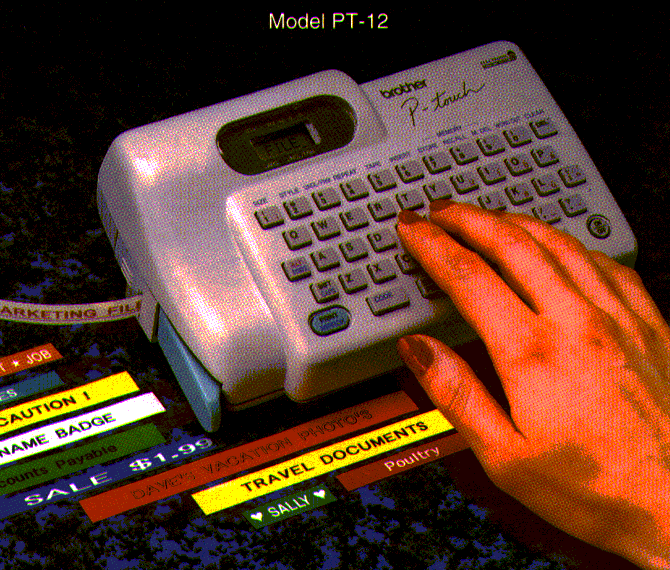
Brother's original PT-12 brochure shows the model with a protective case, a tape, six AA batteries and a tape separator/lettering stick. That historical package display is useful context for someone checking an original box, but it is not a checklist for a used listing today. Ask what is physically included, inspect the tape compartment and keypad, and test a short label before relying on a secondhand unit. A pictured bonus bundle does not establish that batteries, case, tape or separator are still present in the offer you are considering.
The exact product page says the PT-12 has no built-in handle. The images show a compact keyboard machine, but the available exact-model materials do not establish a reliable body size, weight, exact power options, adapter compatibility, cutter behavior or current cassette availability. Those are not minor details if you need the printer to fit a measured drawer, run from AC, cut each label automatically or work through a repeated batch. Treat each as unknown until you can verify the actual unit or locate documentation for its exact configuration.
Who should keep it on the list?
Consider the PT-12 if you already own one, prefer on-device QWERTY entry and your labels fit the documented TZe widths through 12 mm. The product page's label-length control and two-line maximum can be useful for ordinary organizing, but the available evidence does not quantify print height or confirm templates, phone-app design, computer connection, Wi-Fi or Bluetooth. If any of those are essential, select a model whose exact manual and product page confirm that route instead of treating an undocumented feature as absent or present.
For a new household setup, compare a current-reference Brother PT-D220 rather than assuming the PT-12 is a modern equivalent. Both have a physical QWERTY approach and Brother documents TZe tape through 12 mm for the PT-D220, but its current sources describe its own power, print-height and display behavior. It is a separate model, not a guaranteed replacement, and its documentation does not make a used PT-12's bundle or condition irrelevant. Choose based on the exact capabilities you can verify, not on the familiar P-touch name.
How your answers change its fit
Leave earlier equipment out and the PT-12 stays out of the default results because Brother has discontinued it. Opt into earlier models and choose QWERTY with standard TZe tape, and its documented keyboard-and-media plan can qualify. Ask for at least 18 mm TZe, a phone app, an AC adapter, automatic cutting or a measured body dimension, and this assessment does not treat those requirements as met: the required exact-model evidence is not established. That is a useful boundary for an older machine, not a score. If you are comparing a specific unit, verify its cassette, included accessories, power supply and print path before committing to a job that depends on them.
Sources: Brother's PT-12 U.S. product page and original PT-12 brochure.
Key details at a glance
| Print process | thermal transfer |
|---|---|
| Maximum tape width | 12 mm |
| Compatible cassette | The exact PT-12 product page lists TZe at 3.5/6/9/12 mm and separately recommends Brother TC supplies; Brother's exact TC6001 supply page names PT-12 as compatible with the 12 mm cartridge. Preserve two media plans separately. This does not establish all TC widths or cassette interchangeability. |
| Maximum lines per label | 2 |
| Line-count note | Brother’s exact current U.S. PT12 page gives a maximum of two print lines. The exact guide and width-specific line limits are not established here; do not infer two lines on every width. |
| Power choices | Brother’s exact PT-12 brochure promotes a package containing six AA cells. The detailed exact U.S. user-guide URL was unavailable in the checked sources; adapter compatibility and whether a particular used machine includes cells remain unknown. |
| Body dimensions | No axis-assigned exact U.S. dimension set is encoded; the brochure image is not a measurement. |
| What the base package supplies | Brother’s historic PT-12 brochure promotes a deluxe carrying case, one black-on-clear tape, six AA batteries and tape separator/lettering stick. The package shown is not a promise about any used offer. |
| Letter-key arrangement | qwerty |
| Specialist media limits | Only standard Brother TZe widths listed on the exact product page are encoded. Current supply stock, specialty cassette support and legacy TZ compatibility are not established here. |
Use the exact model’s instructions for operating limits, supplied equipment and version differences.
Sources for this assessment
Put the device and its tape system together.
Match the exact model, cassette family, computer or network route and any optional power or touch-panel hardware before buying.