
Your needs, this model
Does it fit your priorities?
Would printing one Avery address or file label at a time be useful beside continuous tape?
The PT-2600 supports separate AV die-cut paper-label cassettes for one-at-a-time address, return-address and file labels; AV media is not a long tape strip.
Explore this need in the finder →Could an older USB computer-design route help when an app-only workflow is not required?
The exact PT-2600 brochure and shared user guide document USB computer design as well as the local keyboard. They do not establish compatibility with current operating systems.
Explore this need in the finder →Do you need 24 mm original TZ cassette tape rather than 24 mm TZe?
The shared model-named guide documents original TZ through 24 mm; Brother's current PT-2600 specification lists TZe only through 12 mm. The two cassette families must not be merged.
Explore this need in the finder →Is automatic cutting essential only for continuous tape, or do you expect it on die-cut paper labels too?
The PT-2600 has an automatic tape cutter; AV media is already die-cut into individual labels and is a separate operating plan.
Explore this need in the finder →Will a 7.6-inch-wide body fit the shelf or desk opening?
Brother's PT-2600 brochure gives body dimensions of 7.6 by 9.5 by 2.6 inches. A width limit below 7.6 inches is too small; allow extra room for cable and tape handling.
Explore this need in the finder →A keyboard labeler with a paper-label side job
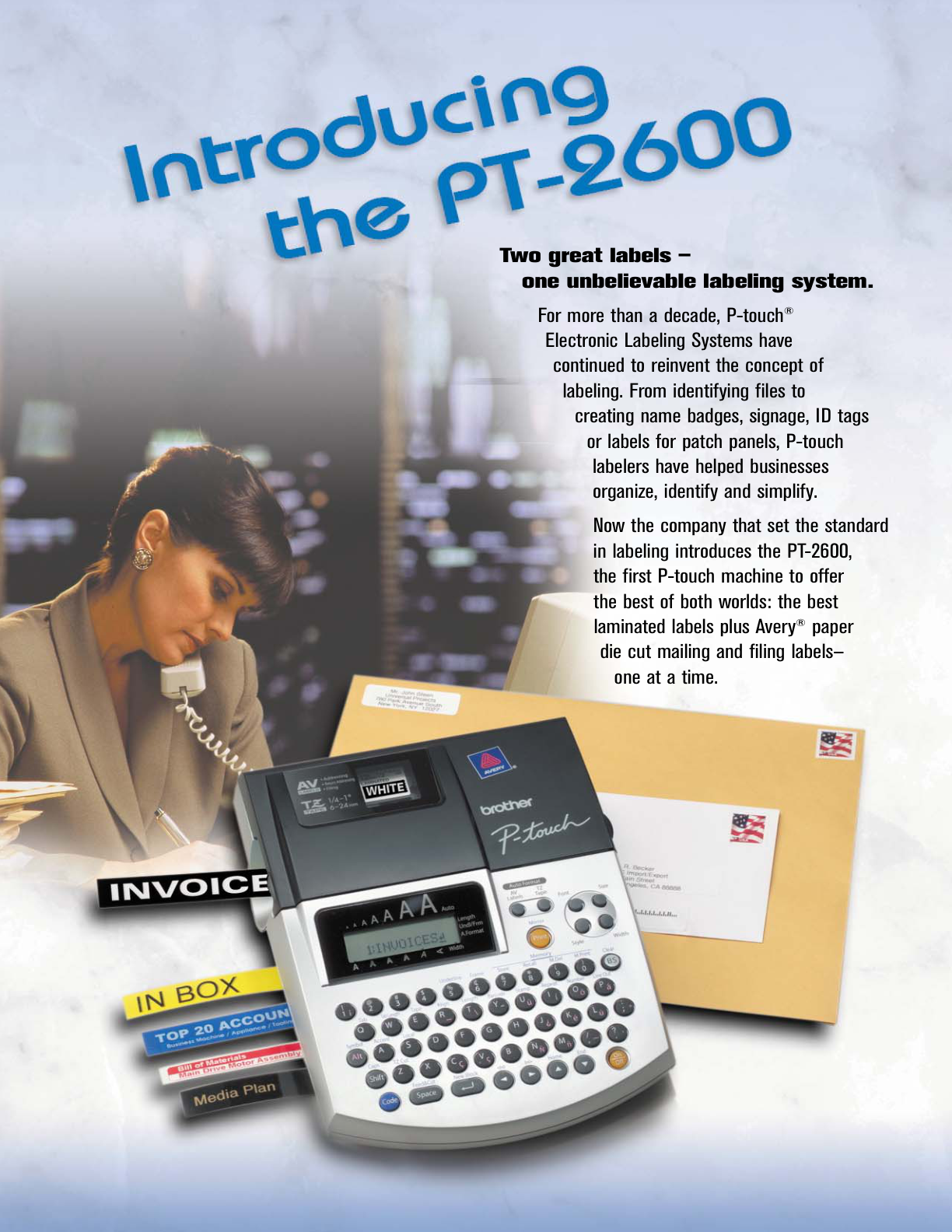
The Brother P-touch PT-2600 is an earlier, discontinued machine for someone who has a reason to keep both laminated tape and individual paper labels in the same setup. Its unusual feature is not a mobile app or a large screen: switch cassettes and it can make a continuous P-touch label or print one Avery address or file label at a time. A QWERTY keyboard works without a computer, while a USB route adds desktop layout options for a compatible older computer.
Two cassettes answer two different jobs
With a TZ cassette, the PT-2600 makes a strip that you cut after printing. Brother’s model-named User’s Guide documents original TZ widths from 6 to 24 mm, with different line limits by width. A wider cassette is useful for a longer equipment label or a multi-line identifier, but it is still one continuous tape system. The built-in automatic cutter belongs to this tape workflow.
The second path uses Brother/Avery AV cassettes. These hold pre-cut paper labels with fixed formats: AV2067 address labels, AV1957 return-address labels and AV1789 file-folder labels. The documented workflow prints one individual label, then the next; it does not turn a plain paper roll into custom-width laminated tape. The brochure says the PT-2600 package originally included an AV2067 cassette with 65 address labels, but that is a 2002 box specification—not a promise that a used unit for sale today contains its starter media.
Keep this difference in mind when you set a hard requirement. The AV stock is already die-cut, so it is not the same job as automatically cutting continuous tape. Likewise, a need for “paper labels” should not lead you to expect sheet-fed printing: this is a cassette-based, one-at-a-time format.
Read the tape-family limits literally
There is a real documentation split around tape width. Brother’s current exact PT-2600 specification table lists TZe media at 3.5, 6, 9 and 12 mm and gives a general two-line maximum. The older model-named PT-2600/PT-2610 guide says to use original TZ cassettes through 24 mm and gives the line count separately for each width. Because those exact-model sources conflict about whether the page-listed TZe family is usable, an essential TZe requirement remains unconfirmed; the page-table claim is retained as a source record, not as a passing match. Do not combine it into “24 mm TZe” or a universal seven-line label. If wide original TZ is the reason you want this machine, match the cassette code—not just the P-touch name—before paying for media.
That older guide also documents the keyboard/display arrangement and the computer route. The QWERTY keyboard and 10-character-by-two-line monochrome display let you compose short labels on the machine. A small preview window is less convenient for long text than editing on a computer. Over USB, Brother describes P-touch Editor and an AV Editor for the paper-label stock, with fonts, graphics and database-related output. This is a legacy connection, not a phone workflow: the brochure’s host-system list is from the Windows 95-to-XP and early Mac era, and it does not establish current operating-system compatibility.
Package and space checks matter on a used machine
Brother’s 2002 PT-2600 brochure lists eight AA batteries, a 12 mm black-on-white TZ starter cassette, the AV2067 cassette, USB cable, software/templates/driver CD, tape separator and user manual in the original package. It identifies the AD-60 as an optional adapter, not an included part. That set is a useful checklist for a second-hand listing, but sellers’ boxes can differ; do not assume an adapter, both cassettes or working legacy software will be present.
The brochure gives the body as 7.6 by 9.5 by 2.6 inches and 2 pounds without tape or batteries. This is a tabletop keyboard machine, not a pocket labeler. It is a sensible fit when paper-label flexibility and a local keyboard matter more than a compact body. If storage is tight, measure the shelf and leave room to change cassettes and route the USB cable.
Who should keep it on the comparison list?
The PT-2600 makes sense first as an existing-owner or careful earlier-model choice: you already use compatible cassettes, need one-off address or filing labels, and are willing to type locally or maintain an older computer. Its mixed-media flexibility is genuinely different from a simple D1 or TZe-only tape maker. But its age is also a material limitation. Brother marks it discontinued, its software route belongs to a much older computer era, and the exact costs and availability of each cassette should be checked before building a workflow around it.
For a current phone-and-keyboard workflow, compare a supported Bluetooth model such as Brother’s PT-D460BT; for compact phone-first output, compare the PT-P710BT. Those are different operating systems and cassette ecosystems, not drop-in replacements for the PT-2600’s AV paper labels. The PT-2610 shares the model-named guide’s functions but is a separate catalogue item with a different historical package; compare the exact box contents rather than treating the two listings as interchangeable.
Manufacturer references: Brother PT-2600 product page, PT-2600 brochure, and the PT-2600/PT-2610 User’s Guide.
Key details at a glance
| Full-color output | No |
|---|---|
| Print process | Thermal transfer |
| Maximum tape width | 24 mm |
| Compatible cassette | The exact PT-2600 page currently lists TZe widths 3.5/6/9/12 mm with a generic two-line ceiling. The shared PT-2600/PT-2610 User's Guide documents original TZ widths 6/9/12/18/24 mm and separate AV die-cut labels. Keep these cassette families and their line limits separate; 24 mm original TZ is not 24 mm TZe. |
| On-device preview characters | 10 |
| Display type | Monochrome LCD |
| Maximum lines per label | 7 |
| Line-count note | The exact shared guide gives width-specific original TZ limits and separate AV-stock limits; the current PT-2600 page's TZe table says two lines. The plans retain those source distinctions rather than promising seven lines on every cassette. |
| Computer design route | ['P-touch Editor 3.2', 'P-touch Quick Editor', 'P-touch AV Editor'] |
| Power choices | The 2002 PT-2600 brochure lists eight included AA batteries or an optional AD-60 adapter; it does not include the adapter. |
| Body dimensions | The exact PT-2600 U.S. brochure lists 7.6 × 9.5 × 2.6 inches; order is the brochure’s dimension sequence. Allow clearance for USB cable and tape feed. |
| Tape cutting | The exact model brochure confirms an automatic tape cutter. The shared guide treats AV labels as individual die-cut output, not an automatic-tape-cut operation. |
| What the base package supplies | Brother’s exact PT-2600 U.S. brochure (2002) lists a black-on-white 12 mm × 5 m TZ starter cassette, an AV2067 cassette with 65 address labels, USB interface cable, CD-ROM with design software/templates/drivers, eight AA batteries, user manual and tape separator. The AD-60 is optional, not included. These are historical documented package contents, not a guarantee for a present-day used seller. PT-2610 is a separate catalogue model and package. |
| Letter-key arrangement | qwerty |
| Wired Ethernet | No |
| USB host for barcode scanner | No |
| Die-cut Avery AV paper-label cassettes | Yes |
Use the exact model’s instructions for operating limits, supplied equipment and version differences.
Sources for this assessment
- Brother U.S. Office & Home catalogue row PT2600 at offset 120, canonical row index 133
- Brother U.S. exact PT-2600 product page
- Brother U.S. PT-2600 brochure, copyright 2002
- Brother U.S. PT-2600/PT-2610 User's Guide v03 (shared exact-model manual)
- Brother U.S. exact shared manual index for PT-2600/PT-2610
Put the device and its tape system together.
Match the exact model, cassette family, computer or network route and any optional power or touch-panel hardware before buying.