
Your needs, this model
Does it fit your priorities?
Can the exact 12 mm TX5311 cartridge cover the label routine you have in mind?
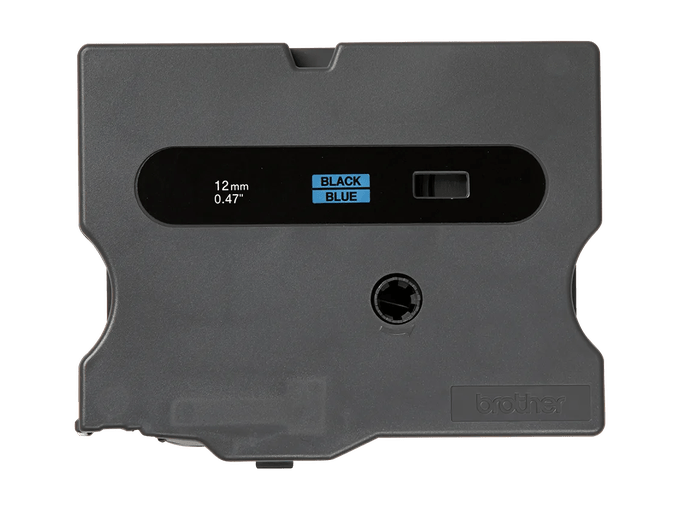
Brother names PT-35 as compatible with TX5311, a 12 mm black-on-blue laminated tape. That confirms this cartridge, not every TX width or the conflicting TZe fields.
Explore this need in the finder →Would the PT-35's reported QWERTY keys and two-line ceiling suit short local labels?
Brother's exact product table reports QWERTY and two maximum print lines. It does not confirm a phone or computer design route.
Explore this need in the finder →Is an app or adapter an essential part of the workflow?
Neither a phone-app plan nor compatible adapter power is established in the checked PT-35 U.S. record, so treat either as a hard requirement the PT-35 cannot currently satisfy.
Explore this need in the finder →What the exact PT-35 record supports
The Brother P-touch PT-35 is an earlier handheld label maker that Brother now marks discontinued. Its exact U.S. product record describes a QWERTY keyboard, a two-line maximum, a label-length setting and thermal-transfer printing on laminated media. Those are the useful basics for a person who already has a working PT-35 and wants to type short identifiers at the machine. They are not a complete picture of its operating requirements, and the model should be approached as an earlier-owner reference rather than a default new-purchase pick.
Choose a refill by the exact code
Brother's current PT-35 product table lists TZe cassettes in widths of 3.5, 6, 9 and 12 mm. But a second exact Brother record matters: the TX5311 supply page explicitly names PT-35 as compatible with that 12 mm, black-on-blue laminated tape. The page calls it a P-touch tape, but the product records do not explain how its TX identity relates to the PT-35 page's TZe field. I would therefore plan around the one named TX5311 cassette if a compatible refill is a hard need, and would not treat the table as proof that every TZe width—or other TX cassette—is a safe match. Read the code on a known working cassette and compare it with the machine instructions before buying another one; matching width alone is not enough.
A direct keypad routine, with a short output ceiling
The reported QWERTY layout favors someone who prefers familiar letter order over composing on a phone. The two-line limit makes sense for a short identifier with a compact second line, such as an object name plus a room or category. The length-setting feature offers a deliberate label-length choice, but it does not make the PT-35 a wide-format or connected design system. A person who mainly prints larger batches, needs computer-created layouts or wants app templates should compare a currently documented connected model instead.
The available exact product record does not provide enough detail to recommend the PT-35 around a particular screen, label memory count, cut method, power source or physical shelf opening. Brother's field called “Standard Memory 15” has no unit or explanation in the record, so it should not be read as fifteen saved designs. Likewise, QWERTY and local text entry do not establish USB, Bluetooth or phone support. If an adapter, an automatic cutter, a saved-label quota or a measured dimension is essential, use a model whose exact instructions specify it rather than filling in these gaps by analogy with a nearby P-touch.
Who should consider the PT-35?
Its plausible audience is an existing owner with a known, working machine, a small supply of identified TX5311 tape and a job that fits short two-line labels. Before relying on a used unit, try a test print and check that the keys, display, cassette loading and cutting action work as expected. Also inspect the cassette itself: an online feature table or a seller's description does not prove which cartridge is included with a particular used device. No current price, seller condition, package contents or stock level is assumed here.
The PT-35 is a poor fit when a label project depends on a wider TZe cassette, confirmed phone or computer design, a known power adapter, automatic cutting or a tight storage dimension. Those are reasonable constraints, but the available PT-35 U.S. record does not establish them clearly enough to turn them into positive matches. A missing fact is not a hidden feature.
How it compares with PT-30 and newer choices
Brother's separate PT-30 product record reports many of the same high-level fields, and the same TX5311 supply listing names both PT-30 and PT-35. That overlap does not prove the two devices are physically identical or that all accessories, internal parts and operating details transfer between them. The useful comparison is narrow: each is a separately named discontinued U.S. model, both have exact TX5311 compatibility, and each needs its own unit and cassette check. See the PT-30 review for its separately assessed limits.
If you need an option for a new purchase, compare the PT-D220 review and other current-reference products on their own documented TZe, power and workflow terms. Brother's replacement recommendation or a shared label-maker family name does not make a newer machine a feature-equivalent replacement. The finder shows the PT-35 only when earlier models are allowed and a suitable documented plan is selected; an essential TZe, app, USB or adapter requirement should remove it rather than assume compatibility.
Bottom line
The PT-35 is worth considering only for an earlier-model routine that matches its known strengths: QWERTY entry, up to two lines, label-length setting and the exact 12 mm TX5311 cartridge Brother names for it. It is not a safe shortcut to broad cassette flexibility or modern software. If you cannot verify the individual machine and its refill code—or if an unconfirmed operating detail is essential—choose a better-documented model instead.
Key details at a glance
| Print process | thermal transfer |
|---|---|
| Compatible cassette | The exact Brother U.S. TX5311 listing names PT-35 and identifies that cartridge as 12 mm black-on-blue laminated tape. The current PT35 product table separately lists TZe and 3.5/6/9/12 mm; the sources do not reconcile those fields. Matching therefore recognizes the one named TX5311 cassette, not TZe or other widths. |
| Maximum lines per label | 2 |
| Power choices | Battery type/count, adapter compatibility and package contents are not confirmed in the checked exact U.S. product/support pages. |
| Body dimensions | The inspected exact U.S. product/support record does not provide PT-35 body dimensions; measure the specific unit if fit is essential. |
| Tape cutting | The exact U.S. product record does not establish cutter actuation; automatic cutting is unknown. |
| Letter-key arrangement | qwerty |
Use the exact model’s instructions for operating limits, supplied equipment and version differences.
Sources for this assessment
Put the device and its tape system together.
Match the exact model, cassette family, computer or network route and any optional power or touch-panel hardware before buying.