
Your needs, this model
Does it fit your priorities?
Will the explicitly named 12 mm Brother M-tape route fit your labels?
Brother’s PT-55 family instructions and U.S. M-231, M-K233 and M-K631 supply pages support a narrow 12 mm M-cassette route for PT-55S. The exact PT55S specification table says TZe instead, so do not treat TZe or the listed TZe widths as confirmed.
Explore this need in the finder →Do you need automatic cutting rather than a button-operated cutter?
The family guide describes a physical cutter button, not automatic cutting. A required automatic cutter rules this model out.
Explore this need in the finder →Is a confirmed QWERTY keypad essential?
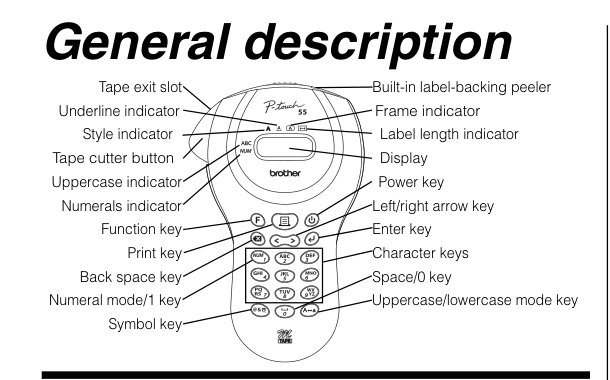
The exact U.S. specification table calls the keyboard QWERTY, but the PT-55-family key diagram shows grouped letter entry on the compact control cluster. Its layout remains unresolved, so a required QWERTY arrangement is not a safe match.
Explore this need in the finder →A discontinued PT-55 variant for owners who want a self-contained labeler
The PT55S is a real, discontinued Brother U.S. catalogue model, but its record is unusually thin. Brother's Office & Home listing identifies the SKU as PT55S and marks the product discontinued; its product page uses only the generic title “P-Touch.” The useful evidence comes from Brother's PT-55 family instructions and U.S. cassette pages, not from a current-feature sales description. Treat this as a used-unit reference, not a modern recommendation for someone who needs a current warranty, reliable availability or a particular workflow.
The family instructions describe a compact, standalone machine: enter text on the unit, choose formatting, print, and operate the physical cutter. There is no documented phone, USB-computer or network design route in the reviewed PT-55 guide. That can be an advantage for occasional short labels when you prefer buttons over software, but it is the wrong starting point if a familiar computer keyboard, phone layout, batch file or automatic cut is essential. If you are looking at a used listing, inspect the model plate rather than assuming a PT-55BM, PT55S and an un-suffixed PT-55 are interchangeable.
Keep cassette choice tied to exact evidence
Brother's current PT55S specification table says TZe and lists several widths, while the Brother PT-55 family guide says to use M TAPE and lists M cartridges that must not be used. The U.S. M-231 and M-K233 supply pages separately name PT-55S in their compatibility lists; Brother's M-K631 page does too. Those exact supply pages and the family guide support a narrow, defensible choice: 12 mm M cassettes such as M-231, M-K233 and M-K631. Do not carry the modern product table's TZe or 3.5/6/9 mm claims into that choice when the instructions and supply records point elsewhere.
There is a second discrepancy worth keeping visible. Brother's M-721 supply listing includes PT-55S, but the PT-55 instructions explicitly warn that M-721 cannot be used. I exclude that cartridge from the dependable route rather than resolving an instruction-versus-supplies conflict by guessing. A used unit should be tested with an exact cassette number that the documentation supports; a cartridge being the right nominal width is not enough. Brother also notes that available supplies can vary by country, so a seller's cartridge photo is not proof that it is included or suitable.
What the manual workflow can—and cannot—do
The family guide describes one- or two-line text, five text sizes, nine styles, several frames, symbols, a label-length setting and a built-in backing peeler. Its two-line mode uses the smallest text size and normal style, so a second line costs visual prominence. The length control lets the operator choose a fixed label length; with automatic length selected, the label follows the entered text. These features suit brief identifiers and names better than dense instructions or small type that must remain readable at a distance.
After printing, the user presses a manual cutter button. The guide warns against touching the blade or pressing the cutter during printing; it does not document an automatic cutter. The built-in peeler is a convenience for separating backing, not a claim that every surface will hold an adhesive under every condition. This family uses non-laminated M tape for the specific compatible route above, which is materially different from Brother's laminated TZe tape. If you need the laminate barrier, select a model with clear TZe documentation rather than assuming this cassette system offers it.
The guide calls for four AAA alkaline batteries and says the unit shuts itself off after five minutes without a keypress. Those details make a portable, occasional-use routine plausible, but the PT55S U.S. page does not confirm exact dimensions, package contents, an included power adapter or a battery-in-box claim. No weight, backlit display, saved-label count or service-life measurement is established here. For an old machine, condition matters: inspect the cassette compartment, battery contacts, display, cutter action and print head before relying on it for a project.
Choose by the constraint that matters
In the questionnaire, PT55S belongs only when you opt into earlier machines and select Brother M tape. An essential TZe requirement is not satisfied by the contradictory specification row; the matcher therefore does not count the PT55S as a TZe choice. The same conservative rule applies to a required QWERTY layout: Brother's feature table labels the keyboard QWERTY, but the PT-55 control diagram shows letters grouped on the small key cluster, so a layout-sensitive buyer should verify the actual machine rather than receive a confident label. Unknown is not a pass.
Likewise, the manual documents local keys and manual cutting, not phone composition, computer design or automatic cutting. If one of those is mandatory, this model should drop out. The current questionnaire can show an earlier PT55S to someone who accepts the manual local workflow, but it should not overstate a capability just because a generic product page contains a populated field.
Alternatives and bottom line
Brother's recommended-replacement list pairs the PT-55S with the PT-D220. That is a useful starting point, not a promise of identical tape, controls or output: compare the PT-D220's own TZe and QWERTY documentation before choosing it. The PT55BM is another separately listed PT-55-family model; Brother's family drawing and compatible-supply pages help explain the relationship, but they do not establish that every suffix has identical U.S. package contents. Our PT55S, PT55BM and PT-D220 comparison sets those limits side by side.
Choose the PT55S only when a confirmed, working unit and a specifically documented M cassette fit a simple local-keypad routine. Its value is the stand-alone control method and a small set of clear formatting functions—not current software, broad media flexibility or automatic finishing. If the used machine cannot be tested, the cassette identity is uncertain, or you need TZe, QWERTY, app or computer input, automatic cutting, exact package contents or a current support commitment, choose a better-documented alternative instead.
Key details at a glance
| Full-color output | No |
|---|---|
| Print process | Thermal transfer; Brother product table and the PT-55 family guide identify a thermal print head. |
| Maximum tape width | 12 mm |
| Compatible cassette | Strict route: the PT-55 family instructions say M tape and name M-231, M-K233 and M-K631; Brother U.S. supply pages explicitly list PT-55S and identify these as 12 mm non-laminated M tapes. Excludes M-721 despite its current supply-page listing because the guide explicitly prohibits it. The exact PT55S U.S. page says TZe and 3.5/6/9/12 mm, so those conflicting claims are not used for a positive match. |
| Maximum lines per label | 2 |
| On-device frames | 9 |
| Body dimensions | No exact U.S. dimensions were confirmed; measure the specific unit if storage fit matters. |
| Tape cutting | The PT-55 family guide describes the physical cutter button after printing; it does not document automatic cutting. |
| Built-in type styles | 9 |
Use the exact model’s instructions for operating limits, supplied equipment and version differences.
Sources for this assessment
- Brother U.S. Office & Home catalogue row at offset 75/index 89
- Brother U.S. PT55S product page
- Brother U.S. PT55S support page
- Brother PT-55 family instruction leaflet, official Brother download (AU English)
- Brother U.S. M-231 supply page
- Brother U.S. M-K233 supply page
- Brother U.S. M-K631 supply page
- Brother U.S. M-721 supply page
- Brother U.S. recommended replacement-model list (2024–25 document)
Put the device and its tape system together.
Match the exact model, cassette family, computer or network route and any optional power or touch-panel hardware before buying.