
Your needs, this model
Does it fit your priorities?
Are the older PT-65’s documented Brother M cassettes the right media?
The official U.S. manual and support specification identify 9 and 12 mm M tape. Brother’s present PT65SCCP widget lists TZe, but that claim conflicts with the detailed family records.
Explore this need in the finder →Do you need a local QWERTY keyboard and no computer link?
The PT-65 support specification lists a 43-key QWERTY keypad and no PC connection; composition is on the device.
Explore this need in the finder →Are you willing to inspect an earlier unit and verify its specific package?
Brother marks PT65SCCP discontinued. Neither its exact product page nor the shared guide identifies a suffix-specific carry case or bundle inventory.
Explore this need in the finder →The exact SKU is real; its package meaning is not documented
Brother’s U.S. Office & Home directory listed PT65SCCP as “Hand-held Electronic Labeling System,” and the exact product page still exists but marks the SKU discontinued. Its description refers to the base PT-65 and a compact general-home labeling routine. The page does not explain what the SCCP suffix changes, list a bundle inventory or show a suffix-specific package view. The shared Brother PT-65 support page and User’s Guide document the family’s core machine, not a special PT65SCCP capability. This review keeps the exact SKU visible while separating what the device can do from what a historic package may have contained.
For the machine, use the PT-65 guide-backed M cassette profile
The official U.S. PT-65 User’s Guide and detailed support specification identify M tape in 9 mm and 12 mm widths. The guide presents the Home & Hobby machine and warns users to use the correct Brother P-touch cassette. Brother’s exact PT65SCCP page also repeats that the base PT-65 is meant for adhesive-backed labels that do not need durable laminated construction. Its live specification widget instead says TZe, laminated tape and 3.5–12 mm widths. Because that widget disagrees with the U.S. PT-65 manual and detailed support table, I would not use it to claim TZe compatibility for this suffix. The supported plan here stays with M tape, not a width-based assumption.
That choice has a practical consequence: the PT-65 is for simple indoor identification, and it should not be selected for wet, frequently cleaned or outdoor labels on the strength of a generic Brother listing. The manual describes six tape colors and the two M widths; it does not establish present-day cassette stock. If you inherit a machine, identify the cassette by its printed code before printing. A 12 mm TZe cassette is not a safe substitute for a 12 mm M cassette just because the dimensions look similar.
A direct-keyboard tool, not a computer printer
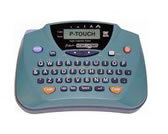
The PT-65 support specification lists a 43-key QWERTY keypad, an eight-character one-row LCD and no PC connection. The manual describes up to 55 characters in a text buffer. For brief storage names, household bins or office drawers, typing on the machine can be more direct than opening software. The tradeoff is that the whole text is not visible at once, and the shared guide contains no app, Bluetooth or Wi-Fi workflow. If you need to create layouts on a phone or computer, this is the wrong branch of the P-touch range.
The support table reports two-line printing, but the manual restricts the second line to SIZE1 in NORMAL style. Maximum print height is 6.8 mm, so large type is not the strength of the device. Brother documents nine preset layouts and several character sizes and styles, but no adjustable label-length setting in its detailed specification. You can display the length of entered text; that is different from setting a fixed output length. A current PT-M95 offers a better-documented M-tape workflow with a larger display and additional on-device templates, while a PT-D220 belongs to standard TZe media. Both comparisons require reading the exact model’s supply notes rather than assuming all Brother cassette devices are alike.
Power, cutting and condition are part of the decision
The manual says to use six AA alkaline batteries. The support specification reports that power source and a manual cutter; it does not list a PC link or an automatic cutter. The shared PT-65 manual has no confirmed AC-adapter route for this SKU, so a buyer should not assume it can sit permanently on a powered desk. Check the unit’s actual instructions before connecting any adapter. A manual cutter is simple but adds a hand motion after each label. The documented 6.0 × 4.2 × 2.4-inch body is still easy to place on a shelf, though the battery bay, cutter and cassette path on a decades-old example deserve inspection.
Before relying on a used PT65SCCP, inspect the battery compartment for corrosion, load a confirmed M cassette, feed and print a test label, and make sure the cut is clean. Check the power and accessory inventory item by item. The manual lists carrying case model 6991 as an available accessory, but that is not evidence that the SCCP bundle included one. Likewise, its general family guide mentions a starter cassette; that does not prove one remains in the package or that the exact suffix originally shipped with the same assortment. The product page’s title and generic description cannot resolve this.
Who should keep it in consideration?
This is a reference for an owner who already has a PT-65, an accessible M cassette and a reason to keep an offline keyboard workflow. It may also help someone evaluate a used listing, but its discontinued status and uncertain suffix package make it a poor default recommendation. If a case or starter tape is the reason for choosing “SCCP,” ask for direct photographs and a written contents list rather than reading those features into the letters. If labels must be laminated, long-lasting or easy to design on a larger screen, compare current devices that document those exact needs instead.
Bottom line
For PT65SCCP, the safe conclusion is narrower than the suffix sounds: it is a discontinued PT-65 handheld with a manual-backed M-tape, built-in QWERTY and battery workflow. The title does not prove a unique operating capability or a special included accessory. Its two-line output requires the smallest normal format, and its labels are not documented as laminated. Verify both the actual package and the M cassette before counting this model as a fit.
Primary references: Brother’s PT65SCCP U.S. product page, the PT-65 U.S. support specification, the PT-65 U.S. manual index and its 2004 U.S. User’s Guide. Brother’s current product-page widget conflicts with the shared family manual on media type, width and lamination; no package-level difference is inferred from the PT65SCCP suffix.
Key details at a glance
| Full-color output | No |
|---|---|
| Print process | thermal transfer |
| Maximum tape width | 12 mm |
| Compatible cassette | The shared PT-65 U.S. User’s Guide and detailed support specification identify non-laminated Brother M tape at 9 and 12 mm. Each exact current product page instead displays a specification widget listing TZe, laminated tape and 3.5/6/9/12 mm. Because that widget conflicts with the older family manual and detailed specification, this fact profile supports M only; a same-width TZe cassette is not inferred compatible. Present-day M cassette availability is not established. |
| Built-in templates | 9 |
| On-device preview characters | 8 |
| Display type | LCD |
| Maximum combined print height | 6.8 mm |
| Maximum lines per label | 2 |
| Line-count note | Brother’s U.S. specification reports two lines. The PT-65 User’s Guide restricts two-line text to SIZE1 and NORMAL style; this is not an unrestricted multi-line layout. |
| On-device frames | 6 |
| On-device symbols | 178 |
| Power choices | The official PT-65 User’s Guide says to use six AA-size alkaline cells. Neither exact suffix page nor the shared manual establishes a PT65SL/PT65SCCP package battery count or adapter in-box; no AC adapter route is credited. |
| Body dimensions | Brother U.S. support specification gives 6.0 × 4.2 × 2.4 in (152 × 106 × 62 mm). |
| Tape cutting | The PT-65 support specification and guide show a user-operated cutter; automatic cutting is not documented. |
| What the base package supplies | Exact PT65SL/PT65SCCP suffix-specific package contents are not listed on the product pages. The generic PT-65 manual refers to a 4 m starter tape for the family and names carrying case 6991 as an available accessory; neither statement proves either item shipped with a particular suffix or a current/used listing. |
| Letter-key arrangement | qwerty |
| Wired Ethernet | No |
| Built-in type styles | 8 |
Use the exact model’s instructions for operating limits, supplied equipment and version differences.
Sources for this assessment
- Brother Office & Home directory, exact PT65SCCP catalogue row
- Brother exact U.S. PT65SCCP product page
- Brother exact U.S. PT65SCCP product-support landing page
- Brother U.S. PT-65 detailed support specification
- Brother U.S. PT-65 User’s Guide v01 (2004-03-22)
- Brother U.S. PT-65 manual index
- Brother U.S. PT-65 official family support image
Put the device and its tape system together.
Match the exact model, cassette family, computer or network route and any optional power or touch-panel hardware before buying.