
Your needs, this model
Does it fit your priorities?
Will you use the PT-85 only with M tape documented in its U.S. brochure, rather than choose by width alone?
Brother's original U.S. brochure says the PT-85 package includes a 12 mm M cassette and supports 9/12 mm widths, while today's U.S. product page lists TZe. Check the cassette logo and unit-specific instructions before replenishing a used machine.
Explore this need in the finder →Should a discontinued label maker appear only when you explicitly include earlier models?
Brother marks the PT-85 discontinued. Its useful record is historical; it is excluded by the ordinary current-reference default and is not given a buying link.
Explore this need in the finder →Can direct on-device entry work, or is a phone app essential?
The U.S. brochure documents the local keyboard workflow but no phone route. Phone-app support is unknown and cannot satisfy an essential app requirement.
Explore this need in the finder →A small earlier label maker with one consequential source conflict
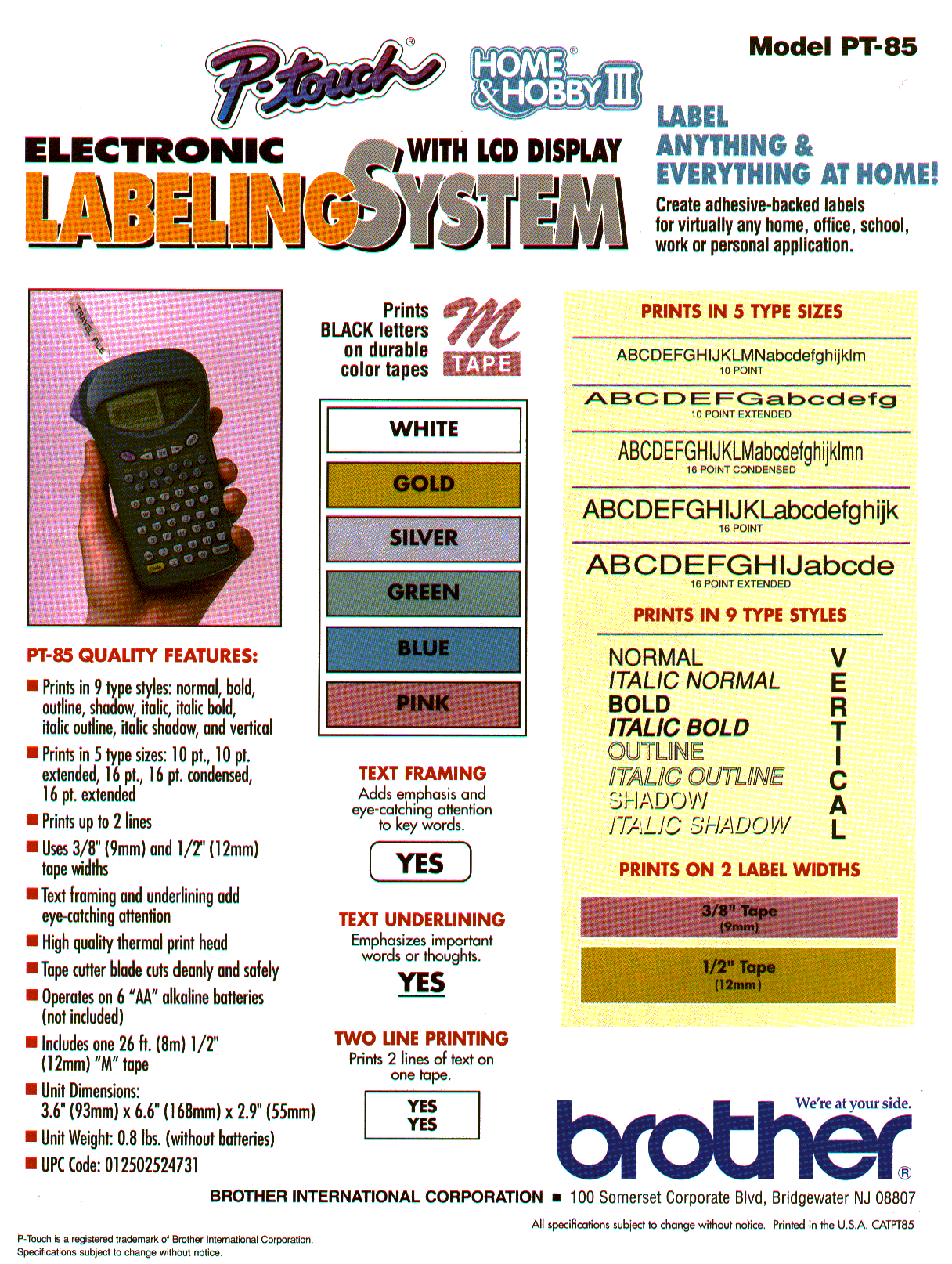
The Brother PT-85 is an older P-touch handheld that Brother still lists in its U.S. catalogue, where the product is marked discontinued. The current page gives the broad name “Electronic Labeling System,” while the original U.S. brochure calls it the Home & Hobby III and identifies the device as model PT-85. That brochure describes a compact, self-contained way to type and print short labels, rather than a computer or phone printer. It lists an LCD display, five text sizes, nine styles, two-line printing, frames and underlining. Those are useful controls for simple household or craft labels, but they are not a reason to buy an unverified used unit without first checking the cassette.
The brochure's tape details do not line up cleanly with Brother's current product page. The original U.S. brochure says the PT-85 ships with one 12 mm black-on-white M cassette and describes 9 mm and 12 mm tape widths. The exact U.S. product page now lists TZe tape at 3.5, 6, 9 and 12 mm. Brother's separate UK instruction leaflet for the same model number says to use only M tape, but that is not a U.S. manual. Because these are contradictory manufacturer records, this assessment does not treat PT-85 as a verified TZe machine. If you already own one, check the tape logo and the instructions for that exact unit before buying refills. Do not choose a cassette on width alone.
What the U.S. brochure supports
For a known-working U.S. PT-85 with its original cassette system, the brochure supports a direct-keyboard routine: enter text on the machine, choose a size or style, and print on a narrow strip. It shows one- and two-line labels, frames and underlines, and a traditional thermal print head. The brochure lists six AA alkaline batteries, not included, and an approximate weight of 0.8 lb without batteries. It also prints dimensions of 3.6 × 6.6 × 2.9 inches (93 × 168 × 55 mm), but does not label the axes in that line; measure the actual machine if a tight storage opening matters.
Brother's UK leaflet for PT-85 supplies a little more operating detail, including a user-operated cutter button, six AA cells, 9/12 mm M cassettes, a five-character display and a 55-character text limit. It is an exact-model document, but a UK leaflet rather than U.S. instructions, so I keep its regional facts separate instead of silently converting them into U.S. specifications. The U.S. brochure confirms a cutter and LCD, but does not state the exact display width or cutter actuation. The current U.S. product page also says “15” for standard memory without explaining whether that means saved labels. That number should not be read as fifteen reusable designs.
Who might still want one?
The PT-85 may make sense as a reference for someone who has inherited the machine with compatible tape, wants a compact keyboard-driven tool, and is prepared to verify the cartridge before printing. Its U.S. brochure describes decorative choices and two-line labels on 9 or 12 mm M tape, which can suit short bin, folder or hobby labels. The small control surface and short-label format are better thought of as a simple local workflow than as a substitute for a desktop editor. The brochure and current U.S. support page do not document phone-app, Bluetooth, Wi-Fi or USB-computer creation, so a required connected workflow is not confirmed here.
There are limits to that use case. The machine is discontinued, and the available U.S. documentation reviewed here does not settle the cassette conflict or fully describe the U.S. manual and operating options. I would not use the brochure's general “durable” wording as proof that an old cassette's adhesive will suit a damp room, rough surface, freezer, cleaner or frequently handled object. Brother's UK leaflet discusses cleaning the thermal head and testing print quality, but follow the instructions supplied for the exact U.S. unit and test the label on the real surface before making a batch. No laboratory durability test was performed for this assessment.
How the choice changes with your supplies
If you want a current-reference Brother model with clearly documented M compatibility, the PT-M95 is a different, more recent handheld with its own U.S. manual; do not assume every older PT-85 control or cassette detail carries over. If your drawer contains standard TZe cassettes, look instead at the PT-H110 or PT-D220, whose reviews document that system. The PT-85 is not a safe shortcut for either choice: the Brother page's TZe field conflicts with its U.S. brochure's M starter-cassette statement, and the specific U.S. instruction booklet was not available on the support page at the check. This review therefore treats it as an earlier model for optional reference, not a current buying recommendation.
The physical image here is taken from Brother's original U.S. PT-85 brochure, not a newly generated product photograph or a retailer bundle shot. It verifies the model's appearance, but the scanned brochure page is not an isolated modern product rendering. The responsible decision is modest: the PT-85 is an identifiable discontinued model with a useful documented feature set, but a buyer should verify the actual cassette and manual before relying on it. If exact refill compatibility, a larger preview, an app or an automatic cut matters, choose a model whose U.S. documentation establishes that exact requirement.
Sources: Brother U.S. PT-85 product page, Brother U.S. PT-85 support page, Brother's U.S. PT-85 brochure, and the UK PT-85 instruction leaflet (regional variant evidence only). This assessment is based on published manufacturer material, not hands-on testing.
Key details at a glance
| Full-color output | No |
|---|---|
| Print process | thermal transfer |
| Maximum tape width | 12 mm |
| Compatible cassette | Brother's original U.S. PT-85 brochure confirms one 12 mm M starter cassette and 9/12 mm widths. The current exact U.S. product page instead lists TZe (3.5/6/9/12 mm); the exact U.S. manual was not surfaced on its support page. Keep M as brochure-confirmed package media, do not match a TZe requirement, and verify an individual used unit's cassette/manual before purchasing refills. |
| Display type | LCD |
| Maximum lines per label | 2 |
| Power choices | The original U.S. brochure specifies six AA alkaline batteries, not included. No alternative U.S. power route is confirmed in the checked sources. |
| Body dimensions | The original U.S. brochure lists 3.6 x 6.6 x 2.9 in (93 x 168 x 55 mm), without naming axis order; measure the actual unit for a constrained storage space. |
| Tape cutting | The original U.S. brochure confirms a tape-cutter blade. The exact-model UK leaflet shows a user-operated cutter button, but the U.S. actuation method is not confirmed by the U.S. brochure or current product page; automatic cutting is not established. |
| Letter-key arrangement | qwerty |
| Built-in type styles | 9 |
Use the exact model’s instructions for operating limits, supplied equipment and version differences.
Sources for this assessment
Put the device and its tape system together.
Match the exact model, cassette family, computer or network route and any optional power or touch-panel hardware before buying.