
Your needs, this model
Does it fit your priorities?
Would you like a full-size QWERTY keyboard on the labeler and wide original TZ tape?
The PT9400 combines local QWERTY entry, a backlit display, and Brother-documented 6–36 mm original TZ cassettes. Brother marks the model discontinued, so include earlier machines only for an ownership or used-unit comparison.
Explore this need in the finder →Do you need 36 mm laminated TZe labels for prominent signs or asset identification?
Brother's U.S. PT9400 page links this model to 36 mm TZe supplies, and its TZe-M261 page names PT-9400 as compatible. Wide cassette stock and a specific used unit still need verification.
Explore this need in the finder →Do you need an older USB computer-design route rather than a phone or Wi-Fi workflow?
Brother's historical product data lists USB, PC/Mac PT-Editor/driver, and computer-designed labels. Current operating-system support is not confirmed; the PT9400 has no confirmed phone-app or wireless route in the reviewed evidence.
Explore this need in the finder →A wide bench labeler for someone who already has a reason to use one
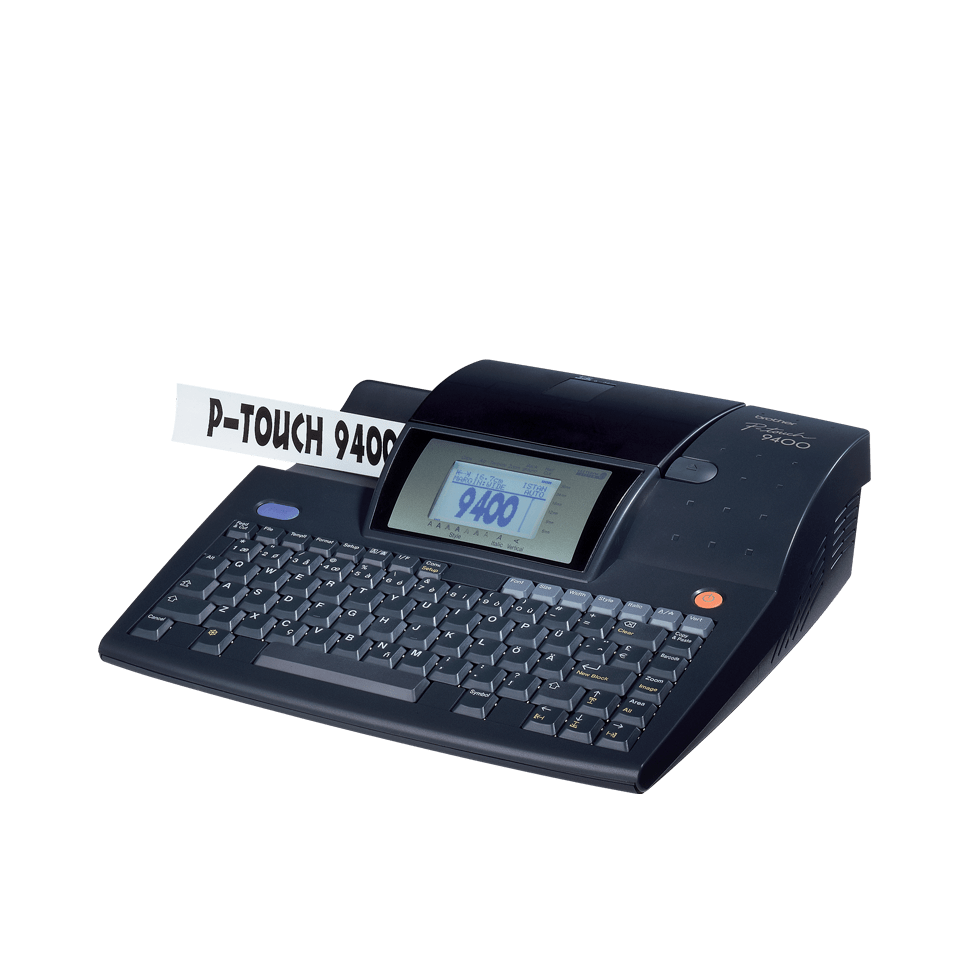
The Brother P-touch PT9400 is a discontinued desktop label maker with a full-size QWERTY keyboard, backlit display, and wide laminated tape. Brother’s U.S. product page describes home and office labeling as well as demanding business, commercial, and industrial applications. That breadth is the point: the PT9400 was not just a handheld for pantry labels. It is most relevant to an owner maintaining a verified unit or evaluating a specific used example, not to someone shopping for a current, supported product.
Its built-in keyboard and cutter do the everyday work
You can compose on the machine itself rather than using a phone or computer for each label. Brother’s U.S. brochure identifies 360-dpi printing, ten fonts, a symbol-and-clip-art library, background and frame formatting, and prepared label designs. These features suit recurring signs, labeled bins, inventory markers, and numbered sequences better than someone seeking a tiny handheld. The brochure also illustrates barcodes and custom stamps as optional uses; that does not mean stamp components are in the box.
The PT9400’s automatic full cutter and half-cutter can separate printed tape while leaving a peelable backing, reducing the handling involved in a batch. Brother calls out its one-touch cassette-access cover, too. Those features make it more comfortable for frequent work than a small labeler that expects you to cut each label by hand. They do not remove the need to inspect a used cutter: on an older machine, confirm that it feeds, cuts, and leaves the backing intact before relying on it for a long run.
Do not collapse the older TZ and replacement TZe systems
The PT9400’s cassette history needs care. Brother’s U.S. brochure lists original TZ cartridges in 6, 9, 12, 18, 24, and 36 mm. A Brother PT-9400 support FAQ from another region says the machine accepts both TZ and TZe; the current U.S. product record lists TZe through 12 mm, and the PT9400 page associates it with 18 mm and 36 mm TZe supplies. Brother’s U.S. TZe-M261 page also names PT-9400 as compatible with 36 mm tape. A Brother support listing in another region includes 24 mm TZe options. That is model-specific evidence for a broad TZe range, but TZ and TZe remain separate media plans; the overseas supply page is not a claim about U.S. stock.
For an old unit, check the cassette family and width before buying a refill. The 36 mm cartridge is especially useful for prominent signs and wide asset labels, while narrower tape is less bulky for ordinary shelf or cable text. A 36 mm cassette is not the same thing as a 36 mm printable text area: Brother’s brochure advertises a maximum print size of about 27.1 mm. The same brochure describes as many as ten printed lines, whereas the current U.S. product-page specification table lists a maximum of two. Because those records conflict, I would not choose the PT9400 for a guaranteed line-count or exact print-height threshold without locating the correct guide for the exact unit.
There is a historical computer route, but not a modern software promise
The PT9400 can work as a stand-alone keyboard labeler, and Brother’s product data also lists a USB cable and an older P-touch Editor/printer driver for PC and Mac. This gives the model a second, computer-connected design route when the software and computer are the ones supported by that generation. It is not evidence of compatibility with a current operating system, a phone app, Bluetooth, or Wi-Fi. If a networked or mobile workflow is essential, those capabilities should be verified on another model rather than inferred from the P-touch name. In the finder, requiring earlier equipment makes this model eligible for comparison; choosing the computer route can fit its documented historical USB workflow, while requiring a phone or wireless print path does not.
Package contents and condition matter more than the old bundle name
Brother’s U.S. brochure lists a 36 mm black-on-white TZ tape, tape separator, guide, and AC power cord in the box. Structured details on Brother’s current product page list different contents, including narrower TZ tape, extra-strength tape, a rechargeable battery pack, adapter, USB cable, and software. Treat the package as unresolved across records and unknown for any used example. Check the specific unit, power-supply label, and cassette. Brother’s full U.S. guide file returns an error; its indexed text carries a model-suffix discrepancy and cannot fill gaps in a used unit’s instructions.
Consider the PT9400 when a working unit, wide cassette support, on-device QWERTY entry, and automatic full/half cutting are the combination you actually need. It is a poor fit if you need a new-machine warranty, known current drivers, a phone or wireless workflow, a precisely verified maximum line count, or a 50 mm color roll. For a present-day keypad-first setup, compare Brother’s PT-D610BT; for a wide, computer- or network-oriented 36 mm station, compare the PT-P950NW, which trades the PT9400’s built-in keyboard for more modern connections. The old PT9400 remains worth documenting, but its discontinued status and uncertain package make it an ownership/reference choice rather than a new-purchase recommendation.
Sources: Brother’s PT9400 U.S. product page, its PT-9400 product information brochure, the TZe-M261 compatibility listing, and Brother’s PT-9400 TZ/TZe guidance and PT-9400 consumables listing. The complete U.S. guide file is currently unavailable from Brother’s posted link, and its indexed version is not treated as a confirmed PT9400 manual.
Key details at a glance
| Full-color output | No |
|---|---|
| Print process | Thermal transfer |
| Maximum tape width | 36 mm |
| Compatible cassette | Original TZ: the exact U.S. PT-9400 brochure lists 6/9/12/18/24/36 mm. Brother documents TZe replacement compatibility for this exact model; the current U.S. PT9400 page lists 3.5/6/9/12, its related supplies include 18 and 36 mm, and Brother's exact-model support listing in another region includes 24 mm. Keep TZ and TZe as separate plans; TZe 24 mm evidence is regional and not a package claim. |
| Built-in templates | 1 |
| Display type | Backlit LCD |
| Line-count note | The current U.S. PT9400 specification table lists two maximum print lines while the model-specific U.S. brochure claims up to ten. The exact full U.S. guide artifact is unavailable; do not rely on either count without checking the matching manual for the unit. |
| On-device symbols | 475 |
| Computer design route | Brother's U.S. product data lists a USB cable and a PT-Editor/printer driver for PC and Mac. This is a historical computer route, not a promise of compatibility with current operating systems. |
| Power choices | Brother's U.S. brochure lists an AC power cord, while current structured product data gives different adapter/battery package contents. AC is documented; a used unit's supply and package are not assumed. |
| Body dimensions | No exact U.S. body measurements were confirmed in the archived exact-model U.S. product page or brochure; dimensions and weight remain unknown. |
| Tape cutting | Brother describes an automatic full cutter and automatic half cutter that leaves a peelable backing; cutter condition on a used unit is unknown. |
| What the base package supplies | Brother's U.S. brochure lists a 36 mm TZ cassette, tape separator, guide and AC power cord; current structured U.S. page fields list different tapes, an Ni-MH pack, adapter, USB cable and software. Exact package status is unresolved and any used unit must be checked. |
| Letter-key arrangement | qwerty |
| Built-in type styles | 14 |
Use the exact model’s instructions for operating limits, supplied equipment and version differences.
Sources for this assessment
- Brother Office & Home directory row, offset 60, index 62
- Brother U.S. exact PT9400 product page
- Brother U.S. PT9400 support page
- Brother U.S. PT-9400 product information brochure, four pages
- Brother U.S. TZe-M261 36 mm supply page
- Brother U.S. TZe-661 supply page (related from PT9400 page)
- Brother U.S. TZe-545 product page (model page recommendation; direct fetch unavailable)
- Brother UK/Europe PT-9400 supplies index (regional evidence, not U.S. bundle evidence)
- Brother U.S. PT-9400 User's Guide PDF URL (direct artifact unavailable; exact suffix unresolved)
- Brother Estonia PT9400 product page image source
- Brother UK PT-9400 TZ/TZe compatibility FAQ
Put the device and its tape system together.
Match the exact model, cassette family, computer or network route and any optional power or touch-panel hardware before buying.