
Your needs, this model
Does it fit your priorities?
Will the compact body and standard TZe system fit your on-keyboard routine?
The PT-H110 is about 4.3 in wide and accepts standard TZe; it is locally operated from its QWERTY keyboard rather than a phone app.
Explore this need in the finder →Do you need the option of two-line text on 9 or 12 mm tape, without an 18 mm cassette?
The PT-H110 can print two lines on 9 or 12 mm TZe, but the product stops at 12 mm and cannot meet a requirement for 18 mm tape.
Explore this need in the finder →Would an optional adapter route help when you are not using batteries?
The H110 supports the optional AD-24ESA adapter, but the base package does not include it; six AAA batteries are another separate supply.
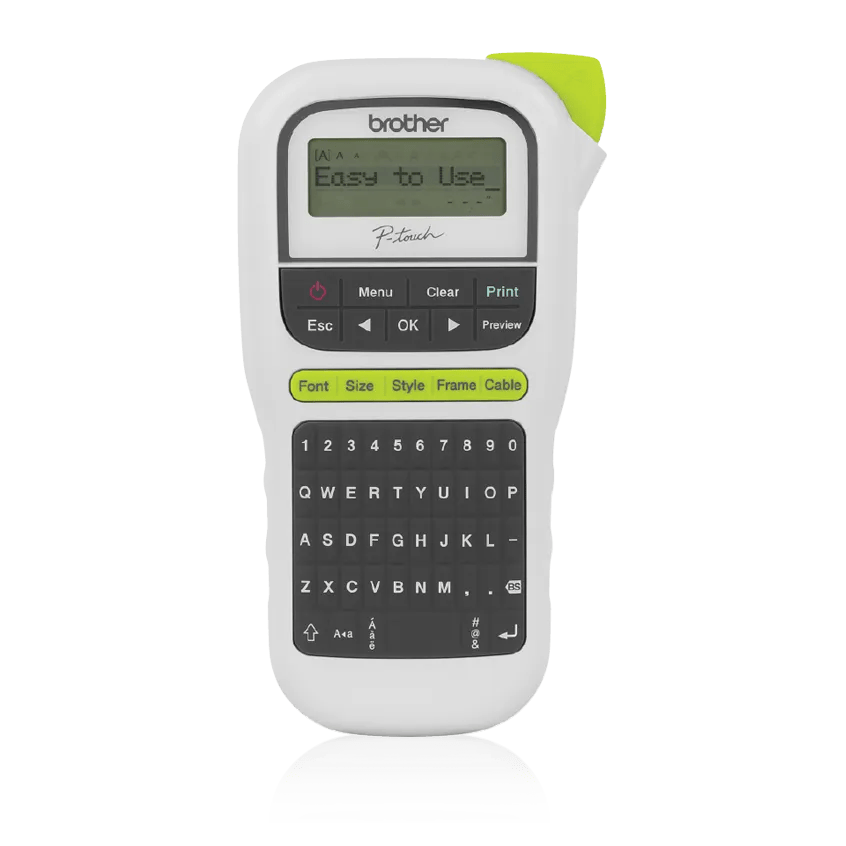
Explore this need in the finder →The Brother P-touch PT-H110 is a self-contained handheld label maker for short names, household organization and basic cable identification when you want to type at the device. It uses Brother TZe cassettes up to 12 mm wide, has a QWERTY keyboard and stores up to 15 label files. It is not a phone-connected printer: its appeal is avoiding app pairing and designing a small label right where you are working.
A useful keypad, with a small preview window
The H110's one-line display shows 15 characters at a time. You can enter a text string up to 80 characters, scroll it, and preview the proposed label before printing, but the screen is not an image-sized proof of every layout. That distinction matters when a longer name must wrap: confirm the actual preview and make a sample rather than assuming a full sentence will be legible on narrow tape. Brother specifies one- or two-line printing; the guide calls for 9 mm or 12 mm tape for two lines. A 3.5 mm or 6 mm cassette is therefore a single-line choice, and 9 mm or 12 mm provides the wider setting for two-line text.
On-device styling is enough for everyday variation: Brother lists three fonts, multiple character sizes and more than 250 symbols, along with frames and simple decorative label formats. Its current technical table is inconsistent about the number of frame types, so I would treat the choices as a modest built-in set, not select the machine by a frame count. The product page also describes a basic cable-label feature. That is useful for making a short cable name, but it should not be confused with the PT-H111's separate Cable Wrap, Cable Flag and Faceplate shortcut workflows.
The TZe ceiling is the important constraint
The H110 accepts Brother TZe tape in 3.5, 6, 9 and 12 mm widths. The base US package includes one 12 mm by 4 m black-on-white laminated sample cassette. Choosing 12 mm gives more room for two lines than the narrower widths, but does not turn this into a wide-format printer. If you routinely need labels wider than 12 mm, the PT-D410 accepts TZe through 18 mm; the PT-D610BT reaches 24 mm and has an automatic cutter. Neither wider machine is as compact in the hand, and each has its own workflow tradeoffs.
TZe is a cassette family, not simply a tape-width label. Brother lists specialty TZe options such as Flexible ID, extra-strength adhesive and iron-on fabric tapes, but check that the exact cassette is intended for the surface and use you have in mind. A laminated cassette is not a guarantee that every label will stay on a curved, oily, rough or frequently washed item. Clean and dry the area, follow the tape instructions and test one label before committing a set.
Portable does not mean cordless forever
Brother gives the body as approximately 4.3 by 8.0 by 2.2 inches and about 0.9 lb before batteries and cassette. It is easy to carry between rooms, but still long enough that a drawer or tool pouch should be measured. Power is from six AAA batteries or the optional AD-24ESA AC adapter; neither is included with the base printer. There is no USB cable, phone-app route or computer-design connection in this configuration. That keeps operation direct, but a user who prefers to compose a large batch on a laptop should choose a different setup.
The cutter is manual. You can print a label and operate the cutter lever, while the chain-print option reduces repeated leading and trailing margins for a series; chain printing still requires a finishing cut, and the manual directs you to cut at its printed marks. Short jobs are straightforward, but a long list of short tags takes more handling than on a unit with automatic cutting. The H110 stores up to 15 files for repeats, a helpful convenience when the same drawer or cable names recur, but it does not replace a carefully checked batch layout.
What changes with the package
The base PT-H110 includes the printer, documentation and a 12 mm by 4 m black-on-white sample tape. Brother's PTH110BP bundle adds three full-length 12 mm by 8 m black-on-white TZe cassettes. That is a supply-value difference rather than a different printer: neither package increases the maximum width, adds a phone app or changes the cutter. Check the package code on the listing and count the supplied cassettes before comparing offers. The Brother product page also presents new and refurbished conditions, so condition and included accessories should be checked separately.
Who should choose it?
The H110 fits a household or home-office routine that mainly needs short, legible labels, a familiar QWERTY keypad, a few decorative choices and standard TZe tape through 12 mm. It also suits someone who wants a general cable-label option without the specialized electrician-style controls of the PT-H111. If a 4.3-inch maximum body width is a real storage limit, its dimensions are worth checking against the opening, with extra room left for tape exit and the cutter.
Choose the H111 instead when a cable wrap, cable flag or evenly spaced faceplate format is essential and you accept its 12 mm maximum. Move to a TZe desktop model if 18 mm or 24 mm labels, computer composition, a larger display or automatic cutting will make a genuine difference. For the H110, the useful trade is modest: in exchange for narrow media and manual finishing, you get a straightforward keypad tool with replaceable cassette choices and no app setup to maintain.
Key details at a glance
| Maximum tape width | 12 mm |
|---|---|
| Compatible cassette | The exact PT-H110 US product page and US User’s Guide identify standard Brother TZe; its listed widths are 3.5, 6, 9 and 12 mm. Tape width alone does not imply support for another Brother cassette family. |
| Built-in templates | 10 |
| On-device preview characters | 15 |
| Display type | Non-backlit graphical LCD, 15 characters x 1 line |
| Maximum combined print height | 9 mm |
| Maximum lines per label | 2 |
| Line-count note | Brother’s User’s Guide specifies 9 mm or 12 mm tape for two-line printing; narrower 3.5 mm and 6 mm widths are treated as one-line choices. |
| On-device symbols | 255 |
| Saved label files | 15 |
| Power choices | Six AAA alkaline or Ni-MH batteries, or the optional AD-24ESA AC adapter listed on Brother’s US specification page. The base PT-H110 page lists batteries and adapter as not included. |
| Body dimensions | Brother’s US User’s Guide lists approximate dimensions W x D x H as 4.3 x 8.0 x 2.2 in and weight about 0.9 lb without batteries or cassette. |
| Tape cutting | The H110 has a hand-operated cutter lever. Chain Print can reduce repeated margins between a run of labels, but the guide still calls for a finishing cut along the printed marks. |
| What the base package supplies | The base PT-H110 includes one 12 mm x 4 m black-on-white laminated TZe sample and documentation. PTH110BP adds three full-length 12 mm x 8 m black-on-white TZe cassettes. The printer mechanism, media width and input route do not change. |
| Letter-key arrangement | qwerty |
Use the exact model’s instructions for operating limits, supplied equipment and version differences.
Sources for this assessment
Put the device and its tape system together.
Match the exact model, cassette family, computer or network route and any optional power or touch-panel hardware before buying.