
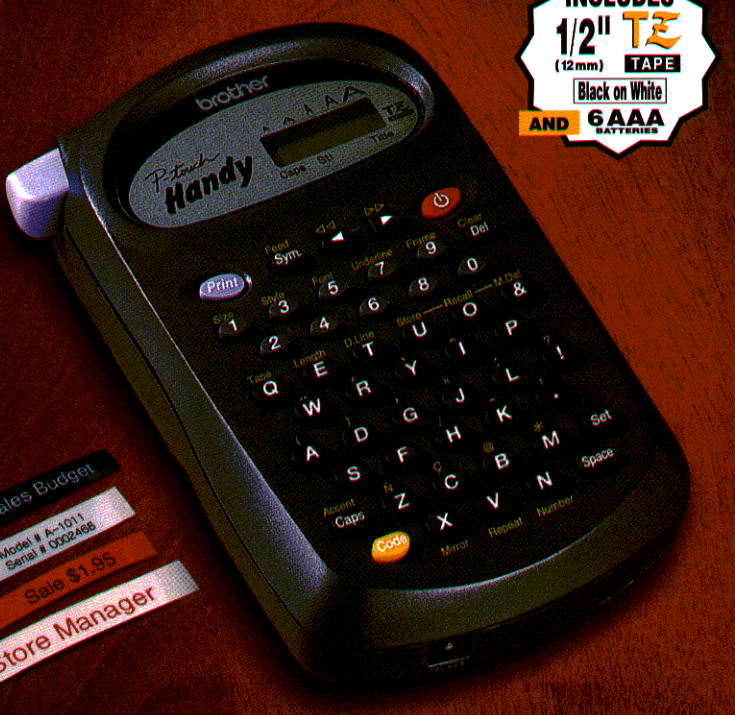
Your needs, this model
Does it fit your priorities?
Are you willing to include an earlier PT-1200 and use the manual-backed original Brother TZ route?
The exact PT-1200 guide names original TZ at 6, 9 and 12 mm. Brother’s current technical table conflicts, so this assessment does not credit TZe.
Explore this need in the finder →Would direct QWERTY entry and a four-character scrolling display work for short messages?
The guide specifies a built-in 49-key keyboard, four-character one-row LCD and up to 55 characters in the working message.
Explore this need in the finder →Do you need two printed lines, while accepting that this means 9 or 12 mm original TZ?
The manual allows two lines only on 9 or 12 mm tape; the narrower 6 mm route is one line.
Explore this need in the finder →Is a hand-operated cutter acceptable for each label?
The exact guide instructs the user to push the cutter button; automatic cutting is not documented.
Explore this need in the finder →Would six AAA cells or an optional adapter suit your power routine?
The exact guide lists six AAA alkaline cells and an optional 7 V / 1.2 A AC adapter; the adapter model and present offer inclusion are unknown.
Explore this need in the finder →The Brother P-touch PT-1200 is a discontinued handheld labeler for someone who wants to compose short text at the machine and is deliberately considering an earlier model. Its case, built-in QWERTY keyboard, and hand cutter are a self-contained routine: type, print, and cut without a phone or computer in the described workflow. The tradeoff is equally important. The exact manual identifies an older TZ cassette system, and the current product page’s technical table disagrees with its own narrative and the manual about tape family. Treat this as a reference for an owner who can verify the machine and supply in hand, not as a safe default for a new cassette-based setup.
Direct entry means a very small editing window
The guide describes a 49-key keyboard with 40 character keys and nine function keys. It is QWERTY, so a person who prefers an on-printer keyboard can enter a message without composing on another device. The screen is only four characters wide by one row. That does not limit a message to four characters: the guide gives a working area of up to 55 characters, with the display acting as a moving window through the text. It does mean that checking a long label or spotting a typo is less comfortable than reviewing a full layout on a phone or computer before printing. The guide does not document an app, USB design route, wireless printing, or a styled print preview; those essential needs therefore cannot be treated as satisfied.
For a label that needs a second line, the operating plan matters. The manual permits two-line printing only with 9 mm or 12 mm tape; 6 mm is a one-line route. The PT-1200 also offers five character sizes, text styles, frames and underlining, vertical and mirror-print options, 70 built-in symbols, label-length settings from 50 to 250 mm, repeated copies and automatic numbering. The manual describes up to nine phrase-memory areas with 300 characters total, while any single working message is capped at 55 characters. Those features help with repeated short inventory or storage labels, but they do not turn the small scrolling display into a modern layout editor. Brother’s product page and brochure count eight type styles; the guide treats vertical orientation as an additional style option, so the practical distinction is eight character treatments plus vertical printing.
Use the manual-backed tape route, not the conflicting table
Brother’s exact PT-1200 page is marked discontinued. In its descriptive text, Brother says the unit uses laminated TZ tape at 6, 9 and 12 mm. The model-specific user guide is more explicit: it says to use only cassettes carrying the TZ tape mark and lists those same three widths. The official brochure likewise identifies a 12 mm TZ starter cassette. However, the current page’s technical table labels the cassette family TZe and includes 3.5 mm. Because those statements conflict on the exact product page itself, this assessment credits only the guide-backed original TZ plan. An essential TZe or 3.5 mm requirement is not a match. Nor does this guide support 18 mm or wider original TZ media. Before relying on a used machine, compare the cassette label and its condition with the older manual rather than assuming all present P-touch tape generations interchange.
The laminated tape format is useful for clearly marking containers, files and equipment, but Brother’s broad statements about resistance to water and temperature are not a promise that every adhesive will bond to every surface or survive every environment. Surface cleanliness, shape, exposure and cassette condition still matter; this is not a substitute for a purpose-built industrial identification system when a process requires a documented specification.
Power and cutting are simple, but package condition is not
The manual specifies six AAA alkaline batteries or an optional 7 V, 1.2 A AC adapter, and automatic shutoff after five minutes without a keypress. It documents a manual cutter button, not automatic cutting. The guide lists a 10 mm-per-second print speed and a body around 3 7/8 by 6 3/8 by 1 7/8 inches, with weight listed as 0.88 lb before batteries and cassette. That is a portable shape, though it still needs the right tape and a hand motion for each cut. The original Brother brochure says the launch package included six AAA batteries and one 12 mm black-on-white TZ cassette. That describes the historic box, not what a present-day used listing includes. Adapter inclusion, any case, tape remaining, printhead condition and working cutter need checking on the exact unit being considered.
Who should include it in a comparison?
Choose the earlier-model option only if you accept the age, can source the documented TZ width you need, and want local QWERTY entry more than a large preview. In the finder, an explicit “include earlier models” choice and a TZ requirement are appropriate; a must-have for TZe, an app, computer design, automatic cutting, a rechargeable pack, or 18 mm TZ should rule it out. Unknown capability is not a substitute for an essential requirement. If your need is the TZe route with a current product specification and easier electronic design, compare the separately reviewed Brother PT-D220 instead. If you want a similar small handheld with more characters visible at once, the PT-1170 review covers that distinct older model; do not assume its screen or cassette details transfer to the PT-1200.
Sources: Brother’s PT-1200 U.S. product page, its PT-1200 user guide, and the official PT-1200 brochure.
Key details at a glance
| Print process | thermal transfer |
|---|---|
| Maximum tape width | 12 mm |
| Compatible cassette | The exact model guide and brochure document original TZ cassettes at 6/9/12 mm. The exact U.S. page narrative agrees, but its current technical table instead says TZe at 3.5/6/9/12 mm; strict matching uses only guide-backed TZ. |
| On-device preview characters | 4 |
| Display type | LCD |
| Maximum lines per label | 2 |
| Line-count note | Exact PT-1200 guide: two-line printing only on 9 or 12 mm TZ; 6 mm is one line. |
| On-device symbols | 70 |
| Saved label files | 9 |
| Power choices | Exact guide lists six AAA alkaline cells and optional 7 V, 1.2 A adapter but does not identify the adapter model or prove inclusion in a present-day offer. The historic brochure lists batteries in the original launch package; current used-package contents are unknown. |
| Body dimensions | Official PT-1200 brochure gives 3.9 × 6.5 × 1.9 inches, width × depth × height. |
| What the base package supplies | The official historic brochure lists six AAA batteries and a 12 mm black-on-white TZ cassette in the original launch box. This does not establish current used-offer contents or condition. |
| Letter-key arrangement | qwerty |
| Specialist media limits | Conservative operating plans credit only the model-guide TZ 6/9/12 mm route; the current exact product page has an inconsistent technical-table TZe/3.5 mm claim. |
| Built-in type styles | ['Normal', 'Outline', 'Bold', 'Shadow', 'Italic', 'Italic + Outline', 'Italic + Bold', 'Italic + Shadow'] |
Use the exact model’s instructions for operating limits, supplied equipment and version differences.
Sources for this assessment
Put the device and its tape system together.
Match the exact model, cassette family, computer or network route and any optional power or touch-panel hardware before buying.