
Your needs, this model
Does it fit your priorities?
Do you specifically need an 18 mm original-TZ label from a familiar QWERTY keyboard?
The PT-1810 guide identifies QWERTY typing and original TZ cassette widths through 18 mm. Its 18 mm plan is not a TZe plan.
Explore this need in the finder →Would preset lengths and formats be more useful than a connected design app?
The guide lists fifteen Auto Format choices, which set length, margins and alignment at the device. No computer connection is specified, and a phone workflow is not documented.
Explore this need in the finder →Can a desk routine with optional AC power and a hand-operated cutter suit you?
The manual documents the optional AD-60 adapter and a push-down cutter lever. The output is not automatically cut.
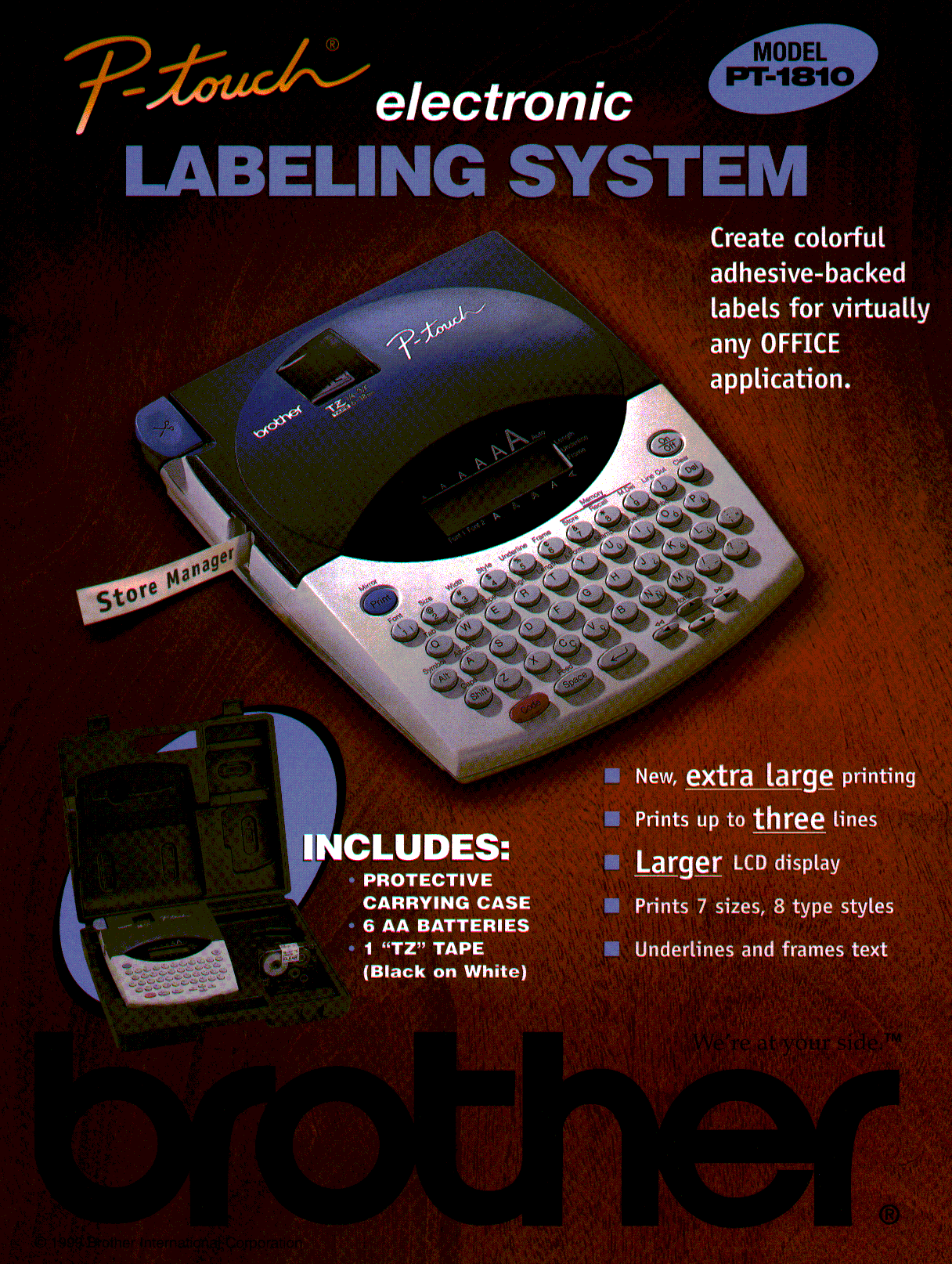
Explore this need in the finder →The discontinued Brother P-touch PT-1810 is a keyboard-first desk label maker for someone considering a working older unit. Its distinguishing strengths are three-line printing on wider original TZ tape and the PT-1810 package’s protective case; automatic cutting, computer design and a compact handheld form are not part of the documented setup.
A spacious keyboard and a display that still makes you check
Brother lists 51 QWERTY keys and a two-line LCD showing 12 characters per row. It is more informative than a one-line handheld display, but not a rendered preview: text is entered at the device and output is printed on tape. The manual records a 99-character working buffer, 300 characters of text memory and at most three lines. Tape width constrains the layout—one line at 6 mm, two at 9 mm, and three at 12 or 18 mm. Three rows help with wider office labels, but check fit before printing.
The format tools are practical rather than modern app templates. There are two named fonts, eight type-style combinations, underlining, frames, and mirror or vertical printing. The manual’s 15 Auto Formats set length, margins and alignment for older storage and filing formats; they are not editable layouts for every contemporary object. It also includes 53 additional symbols and a stamp mode that prepares an 18 mm stamp stencil for a reusable holder. Those are helpful when the task matches, but a flexible desktop design program is not part of the machine.
Keep the cassette restriction literal
The PT-1810 U.S. product description and its original 1800/1810 User’s Guide identify Brother TZ tapes at 6, 9, 12 and 18 mm. The guide explicitly says to use only TZ cassettes. I would not buy TZe just because newer P-touch machines use it: the current shared-ID support table adds TZe, and the product page’s separate live specification panel even lists TZe through 12 mm. But that is not consistent with the exact manual’s TZ-only instruction or the product page’s own description. For cassette questions, follow the model-specific manual and confirm the cassette bay on a used unit before ordering.
The guide describes pressure-sensitive TZ tape with adhesive-backed laminated options and also lists special security, fabric and stamp supplies. That does not mean every special cassette is easy to find now, or that any tape will adhere to every surface. Brother describes the regular labels as water-resistant and suitable for a range of office surfaces; treat that as a property of the matching tape, not a guarantee for a rough, oily, very cold or constantly handled surface. The machine is a monochrome thermal-transfer label maker, not a color photo printer or a sheet-label printer.
A desk machine with hands-on finishing
Brother gives a body size of 178 × 205 × 60 mm (about 7 × 8.1 × 2.4 inches) and 700 g before batteries or tape. It is easy to carry between rooms, especially in the included case, but it occupies a desk rather than a pocket. Printing is specified at 10 mm per second. There is no PC connection in the support specification and no app or wireless input route in the reviewed documentation, so longer text must be entered and corrected on the keys. The physical cutter is a hand-operated lever; it does not automate a stack of labels or apply a half-cut for you.
The machine takes six AA alkaline batteries, and Brother’s original package description includes six. It can instead use the optional AD-60 AC adapter; optional compatibility is not the same as an adapter being in a used offer. Plan around the manual’s memory cautions: text and stored files can be lost when power is disconnected, and changing the six cells within five minutes helps preserve them. The guide specifically recommends the adapter for large type on 18 mm tape because that work can drain batteries quickly. An automatic five-minute idle shutoff is convenient, but it does not make long-term memory independent of power.
Why the PT-1810 rather than a smaller earlier model?
Brother says the PT-1800 and PT-1810 perform the same functions, while only the PT-1810 was supplied with the carrying case. Compared with the earlier PT-1280 reviewed here, the PT-1810 reaches 18 mm on original TZ instead of 12 mm and can print three lines on 12/18 mm tape rather than two lines on 9/12 mm tape. It also adds the two-row display and stamp-film mode; its manual reports 300 characters of memory, while the PT-1280 uses three Favorite keys sized for 80 characters each, a different storage workflow. The PT-1280 has a later, exact-model TZe compatibility FAQ; that evidence does not transfer to this machine. See the PT-1280 review and side-by-side guide before deciding which tape plan suits your supplies.
Brother marks the PT-1810 discontinued. It is worth considering as earlier equipment only if the exact unit works, TZ supply is available for the labels you need, and the case/keyboard/stamp routine is valuable enough to justify an older design. Verify the cassette and power accessories in the specific offer; the historical package list is not a promise about a used box. For a new purchase, choose a current model by its own documented cassette and input route rather than treating this labeler as a modern app printer.
Sources: Brother’s exact PT-1810 U.S. product page, PT-1810 U.S. specifications, the original Brother 1800/1810 User’s Guide, and Brother’s PT-1810 brochure.
Key details at a glance
| Full-color output | No |
|---|---|
| Print process | Thermal transfer |
| Maximum tape width | 18 mm |
| Compatible cassette | The exact PT-1810 product page descriptive text and original 1800/1810 guide document Brother TZ tape at 6, 9, 12 and 18 mm; the guide explicitly says use TZ only. Its separate dynamic spec panel lists TZe through 12 mm and two lines, while the current shared-ID support specification lists TZ/TZe at 6/9/12/18 mm. Keep the exact manual-backed plan to TZ only; do not infer TZe compatibility from the conflicting support fields. |
| Built-in templates | 15 |
| On-device preview characters | 12 |
| Display type | LCD |
| Maximum combined print height | 13.5 mm |
| Maximum lines per label | 3 |
| Line-count note | The original PT-1800/1810 guide states one printed line on 6 mm tape, two on 9 mm, and three on 12 or 18 mm. The exact product page’s separate dynamic specification panel says two lines, while its descriptive text and the original guide say three; use the width-specific manual-backed limit. |
| On-device symbols | 53 |
| Power choices | Six AA alkaline batteries are included in Brother’s historical PT-1810 package description. The original guide also permits the optional AD-60 adapter and recommends it for large characters on 18 mm tape because that can drain batteries quickly. Text and files can be lost when power is disconnected; the guide advises changing the six cells within five minutes and cautions about the AC plug removal order. |
| Body dimensions | Brother’s exact support specification gives width × depth × height as 178 × 205 × 60 mm (about 7.01 × 8.07 × 2.36 inches) and 700 g without a cassette or batteries. Allow extra room for handling the side cassette door and cutter. |
| Tape cutting | The manual shows a tape-cutter lever which the user pushes after printing. The support specification says manual/scissor-type cutter and no auto half cutter. |
| What the base package supplies | Brother’s exact PT-1810 product page and U.S. brochure list a protective carrying case, one TZ tape, six AA batteries, the user guide and a tape separator. This historical original-box list is not a guarantee that a particular used listing still contains those items; the PT-1800 does not have the PT-1810 case per the manual. |
| Letter-key arrangement | qwerty |
| Specialist media limits | The original guide describes stamp-stencil mode for a reusable stamp-film holder using 18 mm stamp film. Its supplies list includes 12 mm TZ-FA3 fabric tape and 18 mm TZ-SE4 security tape. These are distinct specialty consumables; current availability is not established. |
| Built-in type styles | ['normal', 'outline', 'bold', 'shadow', 'italic normal', 'italic outline', 'italic bold', 'italic shadow'] |
| Original TZ maximum width | 18 mm |
Use the exact model’s instructions for operating limits, supplied equipment and version differences.
Sources for this assessment
Put the device and its tape system together.
Match the exact model, cassette family, computer or network route and any optional power or touch-panel hardware before buying.