
Your needs, this model
Does it fit your priorities?
Would a familiar QWERTY keypad make an earlier labeler more useful than a phone app?
The exact U.S. product panel says QWERTY and the model brochure depicts its built-in keyboard. Brother's current ST5 page does not document an app or computer design route.
Explore this need in the finder →Does Brother's listed TZe range through 12 mm cover the labels you make?
The current exact ST5 page lists TZe widths of 3.5, 6, 9 and 12 mm. The old package brochure separately says an 18 mm tape was included but does not identify its family, so that does not establish 18 mm TZe compatibility.
Explore this need in the finder →Would two-line output on the listed TZe cassette fit your short-label routine?
Brother's exact current ST5 panel lists two maximum print lines with the TZe cassette plan; the brochure's playful effects do not document full-color photos or an 18 mm TZe setup.
Explore this need in the finder →Are you willing to consider an earlier-only machine when the exact unit and cassette are verified?
Brother marks ST5 discontinued. Any decision depends on an individual used machine, its exact cassette family and its condition, not on current retail availability.
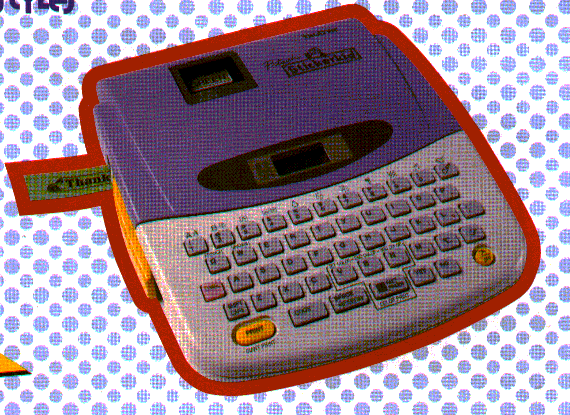
Explore this need in the finder →The Brother P-touch ST5 is an earlier label maker with a very different brief from a plain file-and-cable labeler. Brother’s old U.S. brochure calls the design “Stickerkid,” says it is for ages six and up, and puts games, pictures and decorative effects ahead of workroom throughput. Brother’s current U.S. product page still identifies the ST5 but marks it discontinued. That makes this an ownership or history reference, not a normal new-machine recommendation.
A toy-like design, not a miniature office workstation
The ST5 gives its user a built-in QWERTY keyboard instead of requiring a phone to compose a label. Brother’s current specification panel identifies the keyboard layout, and the model-specific brochure shows a broad, child-oriented keypad with a small display. It is a direct, hands-on way to type a short name or make a playful strip; it is not a documented computer, database or mobile-app workflow. If the person using it expects a familiar tablet interface or wants to prepare batches on a laptop, this old format is a poor match.
What sets the ST5 apart is the collection of playful effects. Its brochure lists built-in pictures, “wacky face” creation, a fast-finger typing game, phrase translation, a secret-code feature, giant print, ribbon making, frame drawing and seven font styles. Those are more distinctive than an office labeler’s ordinary text options, and they can make a quick label feel like a small craft activity. Brother’s current product table gives a two-line maximum and a label-length setting, but it does not give a screen-character count or a measured print height. Treat the line count as the documented limit; do not infer that the display shows a full label or that giant print has a particular millimeter height.
Three-color effects do not mean full-color photo printing
Brother’s brochure advertises three-color printing and three-color tapes, along with four pattern tapes. That is a genuinely different decorative option from the monochrome text most shoppers expect, but the source does not describe full-color photos or a color-roll system. The current ST5 product page specifies thermal-transfer technology and laminated cassette tape. It is therefore more accurate to describe its old three-color and pattern effects than to call it a full-color photo printer. If full-color artwork is essential, compare a machine designed for color-roll output such as Brother’s VC-500W rather than assuming the ST5’s three-color claim covers that job.
Resolve the tape width before buying a cassette
The exact ST5 product page currently lists Brother TZe media at 3.5, 6, 9 and 12 mm, with two maximum print lines. The older model-specific brochure, however, says the package included a black-on-green 3/4-inch (18 mm) tape. That is a real manufacturer-source conflict: the brochure does not identify the starter cassette family, while the current table does not list an 18 mm TZe width. I would use only the page-listed TZe profile for a strict width match and would not promise that an 18 mm TZe cassette fits. For an existing machine, check its tape-bay marking and the actual cassette code before buying supplies. The brochure’s package statement is not enough to merge legacy media with the current TZe profile.
That distinction matters more on a discontinued product than on a new one. Brother’s exact support page exposes FAQs and supplies, but its current support route did not provide a model-specific user guide. The brochure and live specification are useful, but they do not resolve every older cassette detail. Do not buy a large stock of tape on the assumption that width alone determines compatibility.
Power and condition are part of the used-unit decision
The brochure says the ST5 operates on six AA batteries and that they are not included. It also warns that the product has a functional sharp metal edge. That warning deserves attention around a child, especially because Brother marketed the unit for ages six and up; check that an adult can handle the cutter area safely and do not assume the edge is guarded simply because the machine looks playful. The exact brochure gives a unit weight of 1.4 pounds and dimensions of 6.8 × 7.8 × 2.0 inches, but it does not label which number is width, depth or height. Those numbers cannot answer a tight shelf-fit question. The brochure does not establish adapter compatibility, exact cutter operation, or the present condition of any used unit.
Who should keep looking, and what to compare
The ST5 makes sense as an earlier reference for someone who already owns one, wants its playful built-in pictures and three-color effects, and is willing to verify both the cartridge and the condition of the individual machine. It is a weak choice if a current product, guaranteed consumable availability, a full-color photo, an app, a computer workflow, a confirmed automatic cutter or a measured footprint is essential. Those answers should filter it out rather than be guessed from its broad list of novelty features.
For everyday file, shelf and household labels, compare a current keyboard-oriented machine such as the Brother PT-D220; its simpler purpose is a better place to start than a discontinued child-focused design. If full-color output is the actual requirement, read the separate Brother VC-500W assessment and compare its media and workflow directly. Neither alternative recreates the ST5’s toy effects. They are better comparisons when the job is ordinary organization or color imagery rather than playful label making.
Sources: Brother’s exact U.S. ST5 product page and specification panel; Brother’s exact-model Stickerkid ST-5 brochure; and the Brother ST5 support page.
Key details at a glance
| Print process | thermal_transfer |
|---|---|
| Maximum tape width | 12 mm |
| Compatible cassette | The exact current U.S. ST5 specification panel lists TZe and 3.5/6/9/12 mm. The older exact-model brochure says its package includes a 3/4-inch (18 mm) black-on-green tape, without naming the cartridge family. Keep the documented current TZe range at 12 mm and the brochure's package statement as an unresolved source conflict; no original TZ plan or 18 mm TZe claim is made. |
| Maximum lines per label | 2 |
| Body dimensions | The old brochure lists 6.8 × 7.8 × 2.0 inches but does not label width/depth/height axes. Per-axis dimensions remain unknown and do not satisfy shelf-fit limits. |
| Letter-key arrangement | qwerty |
Use the exact model’s instructions for operating limits, supplied equipment and version differences.
Sources for this assessment
- Brother U.S. Office & Home listing row ST5 at offset 120 / listing index 121
- Brother exact U.S. ST5 product page and specification panel
- Brother U.S. model-specific Stickerkid ST-5 brochure, two pages
- Brother U.S. ST5 support landing page
- Brother U.S. exact ST5 user-manual index request (legacy support parameter)
- Brother U.S. exact ST5 specification endpoint request
- U.S. Consumer Product Safety Commission recall search, checked for the exact Brother P-touch ST5 identity
Put the device and its tape system together.
Match the exact model, cassette family, computer or network route and any optional power or touch-panel hardware before buying.