
Your needs, this model
Does it fit your priorities?
Do you need original Brother TZ tape at 18 mm on this older keypad model?
The exact PT-310B brochure lists original TZ widths of 6, 9, 12 and 18 mm. That historical width is separate from the current product page's 12 mm TZe maximum.
Explore this need in the finder →Would the current Brother-listed TZe route through 12 mm suit your labels?
Brother's exact PT310B product page lists TZe at 3.5, 6, 9 and 12 mm, and the exact TZeM921 supply page lists PT-310B as compatible. No 18 mm TZe route is inferred.
Explore this need in the finder →Do you want a self-contained keyboard workflow instead of an app or PC?
The exact brochure shows a 49-key alphanumeric keyboard and 15-character LCD; the product page identifies a QWERTY layout. No computer or app route is documented.
Explore this need in the finder →Do you need the adapter in the package, or is the optional AD-30 sufficient?
Brother lists six AA cells in the original package and an optional AD-30 adapter; current package contents for a used or third-party sale are not established.
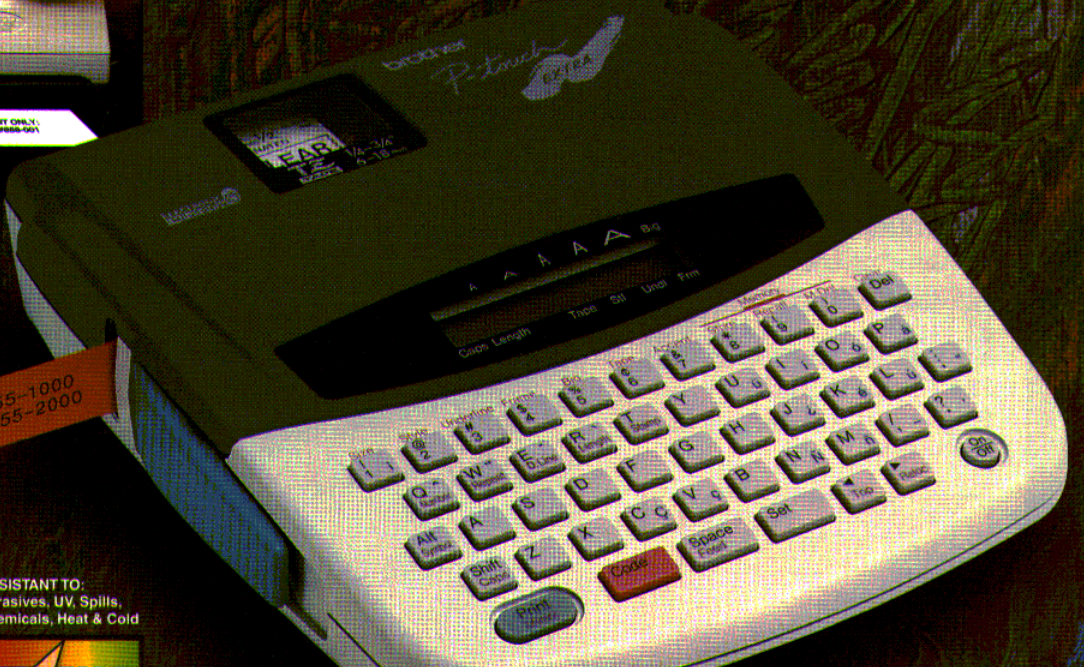
Explore this need in the finder →The Brother P-touch PT310B is an earlier handheld label maker built around a physical keyboard, a small display and cassette tape rather than a phone or computer workflow. The exact Brother US product page marks it discontinued. It belongs in a comparison for an existing owner or a careful second-hand buyer who can verify the unit, tape and power supply—not as an uncomplicated current recommendation. The detail that changes the buying decision is that two Brother sources describe different cassette families: the original product brochure documents TZ tape through 18 mm, while the present exact-model page lists TZe through 12 mm. Those are separate documented plans, not a reason to assume every cassette fits every PT310B.
A direct-keyboard routine with modest proofing space
Brother’s two-page PT-310B brochure describes a 49-key alphanumeric keyboard and a 15-character LCD for editing. The casing shown in that brochure has a familiar QWERTY arrangement, and Brother’s current product record also lists QWERTY. This is the appeal for someone who wants to type a short label at the machine without opening an app, connecting a computer or setting up Wi-Fi. Shelf names, file identifiers, pantry labels and small office markers are the sort of concise tasks it suits better than long layouts assembled from a spreadsheet.
The display is only 15 characters wide, so longer text must be reviewed as it scrolls rather than seen all at once. Brother’s current page lists a two-line maximum, while the older brochure emphasizes type sizes, styles, framing and vertical or horizontal text rather than giving a line-count limit. The brochure also describes eight styles, six sizes, 53 symbols, underlining, mirror printing and repeat/numbering features. Those are useful choices for a small keypad editor, but not evidence of a modern graphic-design workflow. Its 200-character memory claim in the brochure and the current page’s unexplained “Standard Memory 15” do not have a clear shared unit; neither should be interpreted as a count of saved label files.
Keep the TZ and TZe tape evidence distinct
The original brochure is explicit about original Brother TZ tape: widths of 6, 9, 12 and 18 mm. Brother’s current PT310B page, by contrast, lists TZe in 3.5, 6, 9 and 12 mm, and the current Brother TZeM921 supply page includes PT-310B in its compatibility data. For the finder, these are separate plans. An 18 mm original-TZ need can fit the brochure-backed plan; an 18 mm TZe need cannot, because Brother’s current TZe listing stops at 12 mm. Do not compare width numbers without checking the cassette family printed on the cartridge.
I could not inspect a PT310B user manual: the exact Brother manual-index request returned an error page, and the exact support landing page showed FAQs and supplies but no manual content. The discrepancy between the old brochure and the current product data may reflect stale data or a later media listing; the evidence available here does not establish why. If the cassette type is essential, verify the model plate and cassette door on the actual machine and test with the exact cassette rather than buying a box by width alone. The laminated adhesive-backed tape is presented by Brother for varied labeling tasks, but any claim about adhesion on a particular surface, exposure or chemical should be checked against the individual tape and application.
Portable power, optional adapter and a manual cut
The brochure says the machine operates on six AA batteries or an optional Brother AD-30 AC adapter. The original package list includes six batteries, a black-on-clear 12 mm tape cassette, a tape separator/lettering stick and a carry case; it does not list the optional adapter as included. That makes battery use a documented portable route, while a fixed desk setup needs the compatible adapter bought separately unless it is already present. A used sale may omit every original-box extra, so inspect the specific lot instead of relying on the historical package list.
Brother’s tape-margin FAQ names PT310B and instructs the user to push the cutter lever after feeding the tape. That supports a manual cut. I found no exact-model source confirming automatic cutting, so the PT310B should not be counted as an automatic-cutter choice. It can still serve short batches, but the user performs a distinct cut step after printing. The brochure describes characters up to 3/8 inch (9.525 mm), a useful height for readable small identifiers, but the unit’s 15-character screen remains a constraint when you edit longer wording.
Who should consider it—and what to compare
The best fit is someone who already owns a working PT310B, values local QWERTY entry, is comfortable with six AA cells or the optional AD-30, and can identify which of Brother’s documented tape plans applies to that exact unit. The current listing marks it discontinued, and the manual gap, short display and unconfirmed automatic cut are important limits. It should be excluded when a phone app, wireless printing, USB design, automatic cutting, a strict body-size fit, or a current-only shopping choice is essential. Although the brochure gives dimensions of 6.9 × 7.9 × 2.0 inches, it does not label the axis order; measure the actual body for a tight shelf.
If you are buying a new machine rather than maintaining this one, compare the current PT-D410 for a USB-connected TZe route and the PT-D460BT for keyboard-plus-connected editing. Both are separate TZe-era configurations, not media-compatible substitutes for original TZ. The PT310B remains a useful historical reference when its exact cassette and power setup are already known; it is not a shortcut around checking a discontinued machine.
Sources: Brother’s exact PT310B US product page, the linked two-page PT-310B brochure, Brother’s TZeM921 supply listing, its tape-margin FAQ naming PT310B, the 2025–2026 replacement list, and the exact US manual lookup (currently returning an error page).
Key details at a glance
| Full-color output | No |
|---|---|
| Print process | Thermal transfer |
| Maximum tape width | 12 mm |
| Compatible cassette | Brother's current exact PT310B page and TZeM921 compatibility data document TZe from 3.5 to 12 mm. The exact-model brochure also documents original TZ from 6 to 18 mm. Because the exact manual-index route errors and the old brochure/current database differ, treat those as separate, source-specific plans and verify the cassette family on an actual unit. |
| On-device preview characters | 15 |
| Display type | LCD |
| Maximum combined print height | 9.53 mm |
| Maximum lines per label | 2 |
| Line-count note | Brother's current exact PT310B page lists a maximum of two print lines. The older brochure does not state a line-count limit. |
| On-device frames | 5 |
| On-device symbols | 53 |
| Power choices | The original box list includes six AA cells. Brother names the AD-30 as an optional accessory; the brochure does not show it as included. |
| Body dimensions | The Brother brochure lists 6.9 x 7.9 x 2.0 inches without naming axis order; no axis is assigned in the strict fit fields. |
| Tape cutting | Brother's exact-support FAQ covering PT310B says to push the cutter lever. No exact source reviewed documents an automatic cutter. |
| Letter-key arrangement | qwerty |
| Built-in type styles | 8 |
| Original TZ maximum width | 18 mm |
Use the exact model’s instructions for operating limits, supplied equipment and version differences.
Sources for this assessment
- Brother Office & Home directory row, offset 60/index 67
- Exact Brother US PT310B product page
- Brother US two-page PT-310B product-information brochure
- Brother US PT310B support landing page
- Brother US PT310B manual-index attempt
- Brother US tape-margin FAQ covering PT310B
- Brother US TZeM921 tape listing and compatibility data
- Brother 2025–2026 recommended replacement-model list
- Brother US current product-recalls page
Put the device and its tape system together.
Match the exact model, cassette family, computer or network route and any optional power or touch-panel hardware before buying.