
Your needs, this model
Does it fit your priorities?
Would you rather compose a dense label at the machine than rely on a phone, and do you need the PT-550’s original multi-line QWERTY workflow?
The exact U.S. guide describes a 63-key keyboard, WYSIWYG display and up to seven lines for the original TZ workflow. It is discontinued and the TZe route is kept to a separate conservative two-line plan.
Explore this need in the finder →Do you need a wide, multi-line original TZ label with a barcode made at the machine?
The original U.S. PT-530/550 guide says the PT-550 uses Brother TZ tape, lists widths through 36 mm, and documents up to seven lines and barcode generation. Do not transfer that seven-line limit to the separate later TZe plan.
Explore this need in the finder →Do you already have a compatible later TZe cassette and want the exact two-line setup Brother lists for PT550?
The current exact PT550 table lists TZe cassette widths from 3.5 to 12 mm and a two-line maximum. Brother’s exact-model FAQ confirms TZe use, but the record’s related links to wider 18/36 mm tapes do not prove PT550 compatibility.
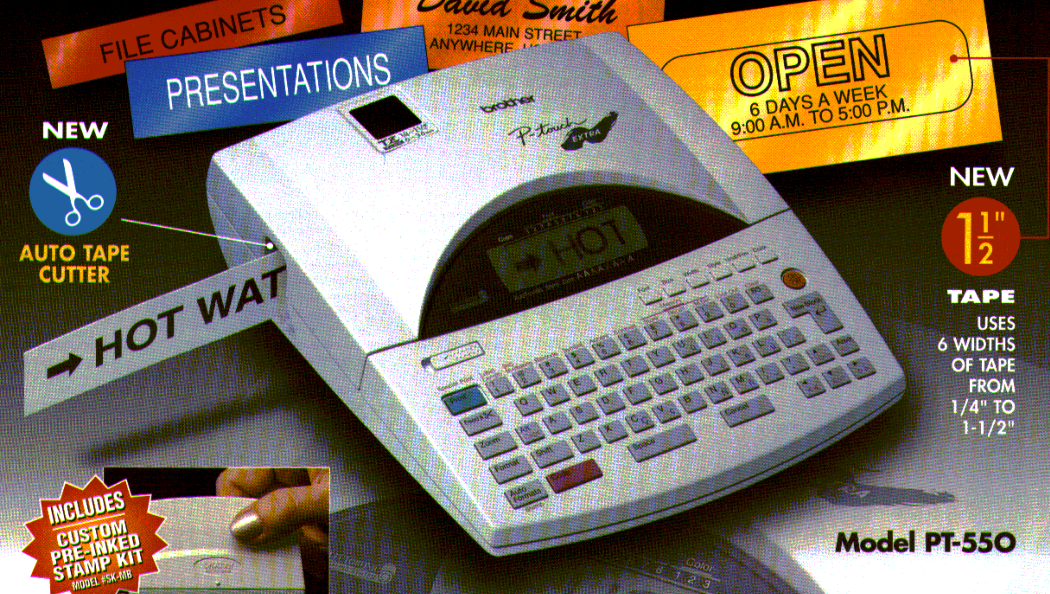
Explore this need in the finder →The Brother P-touch PT-550 is an older desk labeler for an existing owner or a careful used-unit researcher, not a default new purchase. Brother's current U.S. catalog marks it discontinued and unavailable. Its distinctive mix is a 63-key QWERTY keyboard, automatic cutter, broad original TZ tape range, multi-line layouts and barcode tools. Before choosing a used unit, verify the cassette family, cutter, power supply and accessories actually included.
A real keyboard and a roomy layout
The PT-550's 112-by-32-dot LCD is described in its manual as a WYSIWYG display, and its QWERTY keybed lets an operator enter short text at the machine without reaching for a phone. Brother's U.S. guide documents up to seven lines per label, up to five text blocks, repeat copies, numbering and barcode creation. It lists several font families and styles, vertical and mirror printing, framing and label-length settings. This is a more capable composing station than a small one-line labeler: it can create a structured storage or equipment tag, then cut the run automatically. Seven lines is the machine's documented upper capability, not a promise that seven readable lines fit on every narrow cassette; choose a wider tape and check the preview for the actual label.
Its strength is local control: type and check a label at the unit, set repeated or numbered copies, and work without an app-pairing step. The automatic cutter helps with a sequence of labels. If you need a current computer, cloud library or phone workflow, the PT-550's model-specific paper guide does not document those connections. Do not mistake a used cable or generic “PC connection” reference for USB or current software support.
TZ and TZe are separate, evidence-backed choices
The original U.S. PT-530/550 User's Guide says to use Brother TZ cassettes and lists six widths: 6, 9, 12, 18, 24 and 36 mm. It identifies the unit's thermal-transfer, laminated-tape use and illustrates familiar black-on-white, black-on-clear and other color combinations. Brother later published a PT-550-specific FAQ saying TZe cassettes also work. The current exact PT550 specification table gives a separate TZe profile: 3.5, 6, 9 and 12 mm, with two maximum lines. The product record also links to TZE545 and TZE661 in its recommended-supplies area, but those related-item links do not override the explicit 12 mm compatibility ceiling or prove that 18/36 mm TZe cassettes fit this model.
Keep the two media paths distinct rather than merging their maximums. The original guide's 36 mm and seven-line directions concern the older TZ workflow; the current PT550 table expressly lists TZe at 3.5/6/9/12 mm and two lines. The broader product-page description says seven lines on 36 mm without naming the cassette family, so it is not evidence for seven-line TZe output. For a used unit, check the cassette family and width before relying on a layout; do not treat recommended-supply links as a compatibility list.
Desk footprint, power and package checks
This is not a pocket tool: Brother's guide gives a weight of about 2.6 pounds without batteries and dimensions of roughly 8.7 by 10 by 3.4 inches. It runs on eight AA alkaline batteries; the AD-60 AC adapter is optional, so a listing that shows an adapter may be more convenient than a bare unit, but the adapter is not a universal power supply. The original brochure says its retail package included eight AAs, one 26-foot tape, a tape separator/lettering stick, a manual and a stamp kit. The same brochure also advertises stamp kits as accessories. That package description is not a condition report: check the actual used unit for the supplies it claims to include, and treat a stamp kit as unconfirmed unless it is shown.
The PT-550 manual also documents barcode generation and a stamp-making function, but these are not a substitute for checking output. Proofread manually entered codes and test a printed barcode with the scanner and surface intended for use. Likewise, a label's resistance depends on the selected tape and application, not just the machine. Use the instructions for the specific cassette and try a small piece on an inconspicuous area before labeling a hard-to-replace object.
Who should keep one—and who should look elsewhere
Keep the PT-550 on the shortlist if you already have a working unit, like a physical QWERTY keyboard and can use its wider TZ labels, automatic cutter and multi-block layouts. It can also be a useful historical reference for understanding Brother's older cassette system. It is a poor fit if your essential condition is Bluetooth, a phone app, Wi-Fi, USB printing or guaranteed current computer compatibility; those capabilities are not confirmed by the model-specific guide. Its age also makes the condition of the print head, tape feed, cutter, battery contacts and included accessories more important than the original feature list.
For a portable earlier workflow, compare the PT1650: it transfers templates or database records by USB and prints at the handheld, but does not reach the PT-550's 36 mm width or print directly from a computer. The current-reference PT-D610BT offers a 24 mm TZe desktop workflow with Bluetooth and USB. Neither replaces the PT-550's six original TZ widths; choose by the cassette and composition route you can actually support.
Primary sources: Brother's U.S. English PT-530/550 User's Guide, the Brother U.S. PT550 page and linked brochure, the U.S. PT550 support and supply page, and Brother's PT-550 TZe compatibility FAQ.
Key details at a glance
| Full-color output | No |
|---|---|
| Print process | Thermal transfer |
| Maximum tape width | 36 mm |
| Compatible cassette | The original U.S. guide lists Brother TZ at 6/9/12/18/24/36 mm and documents up to seven lines. Brother’s exact PT-550 FAQ confirms later TZe family compatibility; the current exact PT550 table limits that TZe profile to 3.5/6/9/12 mm and two lines. The same product record links TZE545 (18 mm) and TZE661 (36 mm) under related/recommended supplies, but does not label them PT550-compatible; do not infer support beyond the explicit TZe table. Keep the original-TZ and current-table TZe plans separate. |
| Built-in templates | 1 |
| Display type | WYSIWYG LCD, 112 × 32 dots; 23 indicators |
| Maximum lines per label | 7 |
| Line-count note | The original PT-530/550 U.S. guide documents up to seven lines in the older TZ workflow. The current exact PT550 product table separately lists a two-line maximum for its TZe profile (3.5/6/9/12 mm). Actual readable line count also depends on width and layout. |
| On-device symbols | 257 |
| Power choices | Original U.S. guide lists eight AA alkaline cells and optional Brother AD-60 AC adapter. The brochure describes eight AAs in the original package; the adapter is optional, not included as standard. |
| Body dimensions | Brother guide/brochure report about 8.7 × 10 × 3.4 in and about 2.6 lb without batteries; axis order is not explicitly assigned in the source, so width/height physical-fit matching remains unknown. |
| What the base package supplies | The original brochure says its package includes eight AA batteries, one 26-foot (8 m) tape, a tape separator/lettering stick, manual and stamp kit. It also lists stamp kits and a carry case (model 6996) as optional accessories. This brochure does not establish contents or condition of any later used offer; verify the actual listing. |
| Letter-key arrangement | qwerty |
| Built-in type styles | ['Helsinki', 'Brussels', 'Bermuda', 'U.S.', 'Calgary', 'San Diego', 'Istanbul', 'Florida'] |
Use the exact model’s instructions for operating limits, supplied equipment and version differences.
Sources for this assessment
- Brother U.S. Office & Home directory row PT550 at offset 120, listing position #126
- Brother U.S. PT550 product page
- Brother U.S. PT550 support and supplies page
- Brother U.S. PT-550 brochure linked from the exact product page
- Brother U.S. English PT-530/550 User’s Guide, version 01
- Brother PT-550-specific TZe compatibility FAQ (English, UK support locale)
- Brother U.S. exact TZE545 tape page
- Brother U.S. exact TZE661 tape page (reused archived source)
Put the device and its tape system together.
Match the exact model, cassette family, computer or network route and any optional power or touch-panel hardware before buying.