
Your needs, this model
Does it fit your priorities?
Do you need a dedicated satin-ribbon cassette as well as ordinary label tape?
The PT-D215e is documented for both standard TZe label tapes and a separate 12 mm TZe satin-ribbon cassette. The ribbon is a consumable cassette, not arbitrary loose ribbon fed from a spool.
Explore this need in the finder →Would you switch cassettes between routine TZe labels and decorative ribbon?
The manual covers standard TZe widths from 3.5 to 12 mm and one 12 mm ribbon system. The finder keeps the tape-family choice distinct from an essential 18 mm width.
Explore this need in the finder →Is an optional adapter useful when ribbon still requires hand finishing?
Brother documents six AAA cells or an optional AD-24ESA adapter. Tape uses a manual cutter lever, while ribbon is fed and cut with scissors.
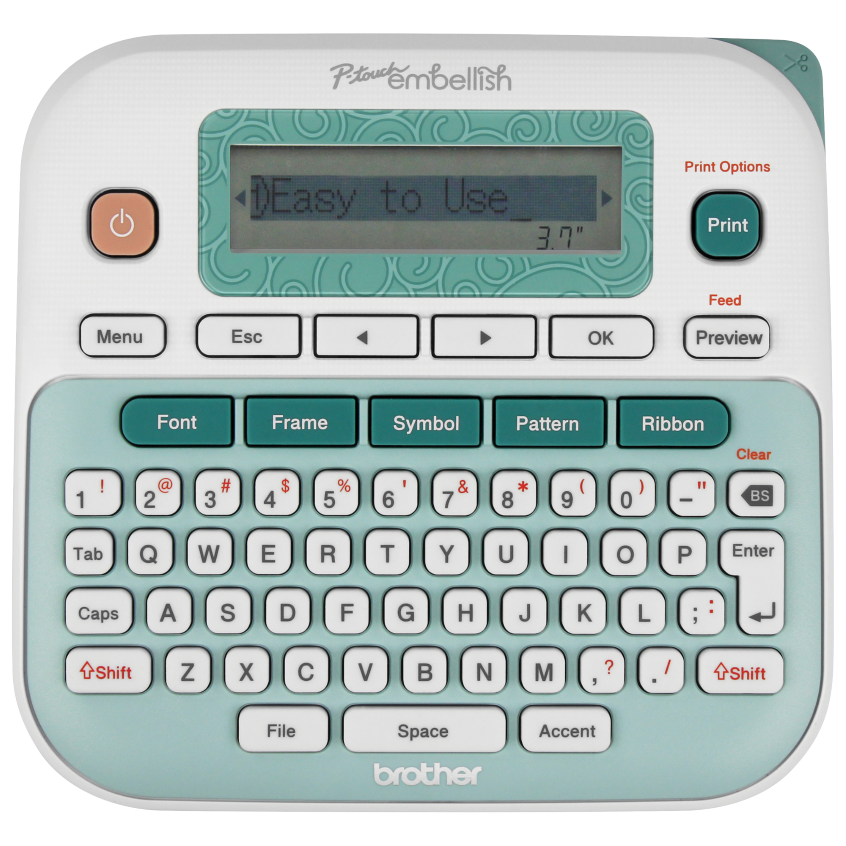
Explore this need in the finder →The Brother P-touch PT-D215e is the unusual keypad maker in this comparison: it can print ordinary Brother TZe labels and use a dedicated Brother TZe satin-ribbon cassette. The observed US package code, PTD215EMIKR, includes a 12 mm gold-on-white ribbon cassette (TZe-R234), while the actual device is named PT-D215e in Brother’s manual and support pages. That makes it a practical craft-and-organization tool if you want a decorative ribbon option in the same machine—not a general fabric printer or a phone-connected design station.
A keyboard-first craft tool, not an app printer
Text is entered on the machine’s physical QWERTY keyboard. Brother lists 14 fonts, 10 font styles, more than 400 symbols and emojis, 90-plus decorative frames, 20 continuous frames, 15 initial marks and 25 patterns. Ribbon templates, repeating text and continuous patterns are aimed at party favors, gift wrap, table settings and small craft runs. The same controls can make ordinary bin, file or craft-supply labels when you fit a standard TZe cassette. The manual describes up to 20 saved label files, with as many as 80 characters in a text label; use a template and the limit is 50 characters.
That library is still operated through a one-line, 15-character display with no backlight. A preview key helps, but Brother cautions that what appears on screen may differ from the printed ribbon or tape. There is no phone-app route, Bluetooth, USB computer design or standalone barcode mode listed for this exact model. Short messages and repeated names suit the built-in keyboard better than elaborate layouts, detailed graphics or long sequences edited at a desk.
Two compatible cassette jobs, with narrow limits
The PT-D215e uses Brother TZe cassettes. Standard label tape is documented in 3.5, 6, 9 and 12 mm widths; two printed lines require a 9 or 12 mm cassette, and maximum combined print height is 9 mm. The special satin-ribbon cassette is only 12 mm wide. Brother also lists 12 mm pattern tape. These materials are not interchangeable merely because they fit the same cassette bay: choose the exact TZe tape or ribbon code for the intended job, and do not treat the model as compatible with the separate Btag system.
For ribbon work, this is not a device that feeds loose gift ribbon from a spool. The ribbon is a dedicated Brother TZe cassette with a printed surface and a set length; the included ribbon is 4 m. That is convenient for short personalized pieces, but creates a continuing supply dependency. If you only need ordinary, functional laminated labels, the ribbon feature may add little to your routine. If the label itself must be 18 or 24 mm wide, this PT-D215e stops at 12 mm and is the wrong choice; a wider TZe machine such as the PT-D410 or PT-D610BT is a more relevant comparison.
Finishing and power remain hands-on
Ordinary tape has a manual cutter lever; it is not an automatic cutter for a batch. Ribbon needs a different finish: Brother’s guide says to feed it after printing and cut it with scissors. You can print as many as nine copies or use numbering, but plan to stay beside the machine for the feed-and-cut work. Continuous printing can save margins, though you still need the final feed and hand cut. The manual warns against pulling tape or ribbon while it is printing or feeding.
Power is six AAA alkaline cells or six fully charged Ni-MH cells, or an optional AD-24ESA adapter. None is listed among the PTD215EMIKR package contents; the package page lists the printer, one gold-on-white TZe-R234 ribbon and the manual, and explicitly says no USB cable. The device is not a rechargeable printer. Brother gives its approximate body size as 6.2 by 5.9 by 2.7 inches and its weight as 1.1 pounds before batteries and cassette. The compact footprint is manageable on a craft shelf, but the battery count, separate adapter and ribbon cassette all belong in the setup decision.
Who it suits—and when another model is clearer
Consider the PT-D215e when you want to make short decorative ribbon messages and still want one keyboard machine for ordinary TZe labels. It is especially distinct when satin ribbon, fixed ribbon templates or repeating patterns are essential. In the finder, the ribbon-cassette requirement narrows the result to models with documented ribbon support; choosing an essential phone-app route, an automatic cutter or 18 mm TZe width excludes this model for real capability reasons.
For everyday labels without ribbon work, compare the PT-D220: it also uses TZe through 12 mm, while offering a simpler standard-label role. If a connected computer workflow or 18 mm TZe is more important, the PT-D410 offers those documented differences but not a ribbon cassette in its reviewed configuration. A phone-designed TZe label instead points toward the PT-D460BT or PT-D610BT; neither should be mistaken for this ribbon model.
Before buying, check the full code and exact carton contents. Brother’s PTD215EMIKR listing identifies the included ribbon as 12 mm by 4 m, while its support materials call the device PT-D215e. Test any adhesive label on the actual clean, dry surface and follow the tape’s own instructions; a compatible printer does not guarantee adhesion on every material or under every condition. This assessment draws on Brother’s US product page, US specifications and US English User’s Guide v03, not on independent print-quality, endurance or surface-adhesion tests.
Key details at a glance
| Maximum tape width | 12 mm |
|---|---|
| Compatible cassette | Brother TZe cassette system: standard label tapes in 3.5, 6, 9 or 12 mm, a separate 12 mm satin-ribbon cassette, and 12 mm pattern tape. Use only Brother TZe supplies. |
| Built-in templates | 5 |
| On-device preview characters | 15 |
| Display type | One-line graphical monochrome LCD with no backlight; Brother's manual warns the preview may differ from the printed result. |
| Maximum combined print height | 9 mm |
| Maximum lines per label | 2 |
| Line-count note | The US User's Guide specifies 9 or 12 mm tape for two-line printing; text and pattern templates are limited to 12 mm tape. |
| On-device frames | 95 |
| On-device symbols | 400 |
| Saved label files | 20 |
| Power choices | Six AAA cells or optional AC Adapter AD-24ESA; neither power source is listed among the PTD215EMIKR carton contents. It is not rechargeable. |
| Body dimensions | Approximate W x D x H: 6.2 x 5.9 x 2.7 in; about 1.1 lb without batteries or cassette. |
| Tape cutting | Label tape is cut by a hand lever. Brother instructs users to feed printed ribbon and cut it with scissors. It is not an automatic cutter. |
| What the base package supplies | Brother's exact PTD215EMIKR page lists the PT-D215e printer, one gold-on-white satin-ribbon cassette TZe-R234 at 12 mm x 4 m (13.1 ft), and the User's Manual. It says no USB cable is included; batteries and the optional adapter are not listed in the box. |
| Letter-key arrangement | qwerty |
| Built-in type styles | 10 |
Use the exact model’s instructions for operating limits, supplied equipment and version differences.
Sources for this assessment
Put the device and its tape system together.
Match the exact model, cassette family, computer or network route and any optional power or touch-panel hardware before buying.